
Get Low
 |
| “Edge of the World” – Florida Bay – Everglades National Park |


Arthur Marshall Foundation: It’s My Everglades
Two months ago I was invited to join a canoe expedition sponsored by the Arthur R. Marshall Foundation. It was my job to document their third consecutive year of traveling the historic River of Grass. The leg of the trip that I joined was from Sawgrass Recreation Park down to the Tamiami Trail, about 76 miles.

Two years ago the expedition started at the Arthur R. Marshall Loxahatchee Wildlife Refuge and planned to follow the water all the way down to Florida Bay, in order to raise awareness of South Florida’s need for clean, free-flowing water. Today the expedition has become a massive effort to involve the public, especially children, with Everglades restoration. Embracing the new technologies, we would set up live from-the-field video classrooms using iPads with elementary schools all over south Florida and describe to the students what we saw and experienced while on the water.

 I love multi-day expeditions and I jumped at the offer. I made sure to pack as light as possible, even though my camera gear alone weighed 60 pounds. In order to compensate I left all articles of what I deemed “unnecessary” at home only to learn that I would be the only one without a pillow, sleeping pad, or camp chair. Bummer. Fortunately though, I had no problem sleeping after the gourmet meals, provided by the phenomenal cook Gisa Wagner. I’m pretty confident this was the only time I’ve had lamb stew and fresh broccolini marinara pasta, of course with grated parmesan cheese. This is my style of camping!

walked around the campsite with headlamps ablaze.
On the last day of our trip we pulled into the Tamiami Trail boat ramp. Only a few hours later, the Florida Wildlife Corridor Expedition team, Carlton Ward Jr, Joe Gutherie, and Elam Stolzfus rolled in exhausted from the last grueling 5 days of their journey from Florida Bay. When I saw their faces, I felt horribly guilty of those delicious calories I had marinating in my stomach. Well, sort of.

I hope you enjoyed the video. I must say thank you to the Arthur Marshall Foundation and the talented and brilliant paddlers I met while on the trip. I can’t wait until next year. Also a special thank you to Susan Sylvester, who is entirely to credit for any footage I got while on the water. I promise I’ll try to rig up a system where I can shoot and paddle at the same time for our next trip!
Lost and Found

I love watching adventure shows where the protagonist drops in on an island and must use his immediate resources to survive or escape. I’m always skeptical too, of the serendipity that Bear Grylls just happens to find a 30 foot rope, a lighter, or gallon jugs half-filled with potable water washed up on the shores. Surely, the producers must have planted some of that stuff before filming. I held this skepticism until I started exploring the islands in Florida Bay for our spoonbill research with Audubon. Now, I find myself eager to go to work if not just for the spoonbills but also because I never know what I’ll find while walking through mangrove tangles or kayaking along the mud flats.

The most common things I find are colorful stone crab buoys which at a distance have fooled me to believing there were flamingos in the central bay. I have also started a collection of drink cozies with faded tackle shop labels. Antique bottles are a great treasure to find and I have a couple that date back a century. There’s no shortage of homeless sandals either. Crocs brand are the most common, and if anyone needs a size 9, 10, or 12, then I have you covered. Why is it always the left shoe that people lose?

It’s no surprise really. With all the boaters, residents, and visitors to the Keys and Everglades a few things are bound to arrive on the islands of this 850 square-mile wilderness. For years the Everglades was renowned for its lawless backcountry allowing drug smugglers a perfect location for trafficking. Veteran fishing guides who wish to remain nameless, muse on the days of their biggest catches, landing large “square groupers,” caught in the tidal flats which would fetch $200,000 at market price.

While contraband busts rarely run the headlines, the Everglades remains vast and largely unpatrolled by park officials. Just last week, while exploring an island in the northwest Bay, I saw something strange washed up on a sandy beach.

A blue vessel, made of canvas stretched over two large tire inner tubes with oar-locks, and a heavy plastic keel, sat abandoned at the high tide line. At closer inspection, inside the cockpits were cans of tuna, varying flavors of soda, and a couple of sweaters. Although the labels slightly worn, I could tell immediately where this raft came from. It’s incredible to think two people floated in open ocean aboard this backyard-assembled dinghy. Being only 90 miles from Cuba, Florida Bay is really the perfect destination for refugees. I just hope they didn’t get too antsy and try to swim the remaining 5 miles to mainland through the shark and croc-infested water. For a moment, I looked up, scared to find the stranded sailors watching me from the trees, but at this point they were long gone.

I may not be Bear Grylls, but I’d like to think that if I were to be stranded on one of these islands, I’d be able to survive just fine. With my luck, I’d just hop on the next abandoned life raft and paddle safely to shore, gorging on canned tuna and orange soda.
At a Loss

Water management in south Florida has been at the forefront of environmental and political debate ever since the turn of the twentieth century. Surprisingly, even today with all that we know of the Everglades and its significance to Florida and imperiled watersheds all around the world, we’re still struggling to get it right.
The taxes to be cut are taxes on homeowners. If you have a home valued at $100,000 then you are saving $15 a year from this monumental tax break. I know what you’re thinking, “holy crap, what am I going to do with all this extra cash now?!” The possibilities are endless. At the cost of science and hundreds of jobs, we can all enjoy a few more lattes from Starbucks or that leopard-print Snuggie we’ve always wanted.


He and I flew out early in the morning over the ridge and sloughs of the southern Everglades. Restricted water flows had started to show their subtle but detrimental affect on the landscape, now clearly visible at 800 feet. He looked on, despondent and removed, like an artist stepping back from the canvas to see strokes and details incongruous with his original vision.

 When we landed at Rocky Creek and hauled away the first load of boardwalks, Jerry had trouble finding the words to express his disappointment. It took days to build the site, months to scout it out, and years to figure out its place in the greater watershed. After a matter of hours, it was completely gone. The helicopter carried out the last load and we sat silent, tired, and wet under the dissipating hum of the propeller. Jerry looked on as it faded into the horizon, but stayed watching, perhaps hoping that it would turn back around.
A deep sigh from a frail resolve was the only audible sound I heard as we crouched in the water, quietly waiting to be picked up. Disappointing is hardly the word. Heartbreaking is more appropriate. I could see it in his face and weighing on his shoulders. Jerry and a number of other biologists have invested their lives protecting the Everglades through science and reason. Ever since restoration became a statewide conversation they have been Florida’s most trusted voices. Now their throats are hoarse from screaming into deaf and often indifferent ears.
A Gator Tale

This past weekend, I met up with a photographer friend Paul Marcellini in Big Cypress National Preserve to explore and photograph some new areas. Making sure to stay as far from the trail as possible, we used Paul’s iPhone to navigate through the maze of cypress domes, praying that he wouldn’t run out of service as we pushed deeper and deeper into unknown territories. At the tail end of the dry season, we expected to cover a lot of ground since we wouldn’t have to slog through any blackwater. We set our bearings for gator holes which we knew would be the only places with water and of course, american alligators. Little did we know, however, that from start to finish we would cover all facets of an alligator’s life.
Tamiami trail is known for its deep canal that runs along the the northern side of the road and provides perfect basking habitat for american alligators. Every once in a while a brave gator will try to cross the road. Sadly, some of the locals see this as sport and will jokingly refer to them as speed bumps. Accidents do happen, but it’s hard to imagine a 10 foot alligator coming out of nowhere.

By the time we got to our starting point the sun was high enough in the sky that we didn’t expect to shoot much in the cypress domes. Although 8:00 is by no means too late, once under the canopy it becomes difficult to avoid intense tonal contrasts with mottled light. Shrugging, I turned to Paul and said, “I guess we’ll have to shoot things a little tighter.” I had no idea what that harmless plan would lead to.
Throughout our 3 mile trek, we encountered 11 different gator holes. Gator holes are clearings typically in a cypress strand where alligators have excavated plants and debris. In doing this, they ensure when water is scarce, they will always have a self contained water source to feed on fish until the rains return. Each gator hole had its own resident and we were surprised to find hatchlings swimming around so early in the season.

We even came across a gator hole where the resident alligator hadn’t been so fortunate. It’s hard to fathom that a gator of that size would die of natural causes, so I’m suspecting foul play. Whatever the case it smelled horrible, but that didn’t stop the black vultures from enjoying a nice Sunday brunch.

Around 10:00, we arrived at a hole where a mother and her hatchlings swam amongst splashing fish. She watched us with a weary gaze as we skirted her home. The mud surrounding the water was deep and heavy. Looking up, we noticed a tail and snout sticking out from the muck. Looks like we found our “tight shot.” Hesitating, just a little, we got in close with our macro lenses relying on the weight of the mud to discourage any movement from the gator.

Certainly a manageable size, at 6-7 feet, Paul and I were confident but grateful the other was there with a helping hand, or a camera at least. So we got in closer.

Slowly, the gator brought its head out of the mud and let us know it was his mud. I’ve imagined a photo like this for a long time and I wasn’t going to blow it. I attached a wide angle lens and lowered my camera as close to the mud as possible. The gator burped and hissed, releasing the smell of rotting flesh into the air and I triggered the shutter.

After a few frames, we backed away slowly and thanked the gator for its hospitality. It was a raw and beautiful experience sharing space in the lair of a dragon. When I got home I called a friend and told him about our afternoon, excited to show him the pictures. He laughed, agreed it sounded like an adventure, then casually told me he had just returned from swimming with over 40 gators. While such a thing is far beyond my comfort zone, it’s not so uncommon down here. Still, I’d much rather photograph them from terra-somewhat-firma. Although, now that I think about it, an underwater photo looking up at their silhouetted bodies against an aqueous sky sounds pretty tempting… hmmmm….
Anhinga Trail

There are only a few places I’ve been for bird watching that rival the Everglades’ Anhinga Trail. This isn’t one of my “secret spots,” either. I’m pretty sure every tourist from New York to California knows that in the dry season, this small section of boardwalk and previously-quarried pond offers front row seats to the wading bird and alligator show. As fish are bottle-necked into the deeper waters they stand little chance against the patience and sharp bills of the herons and anhingas which line the banks.
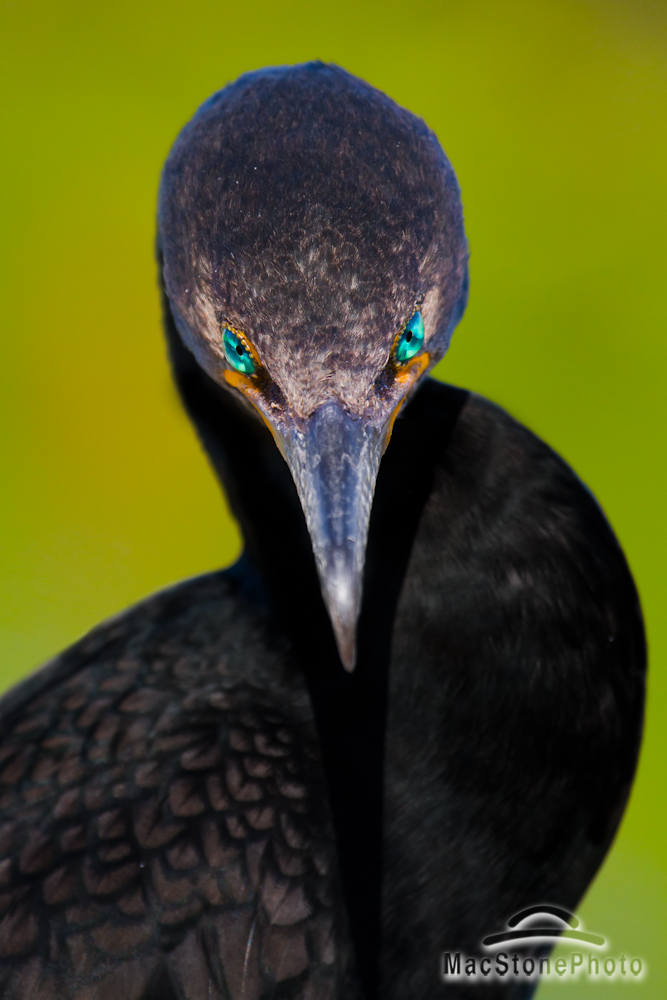
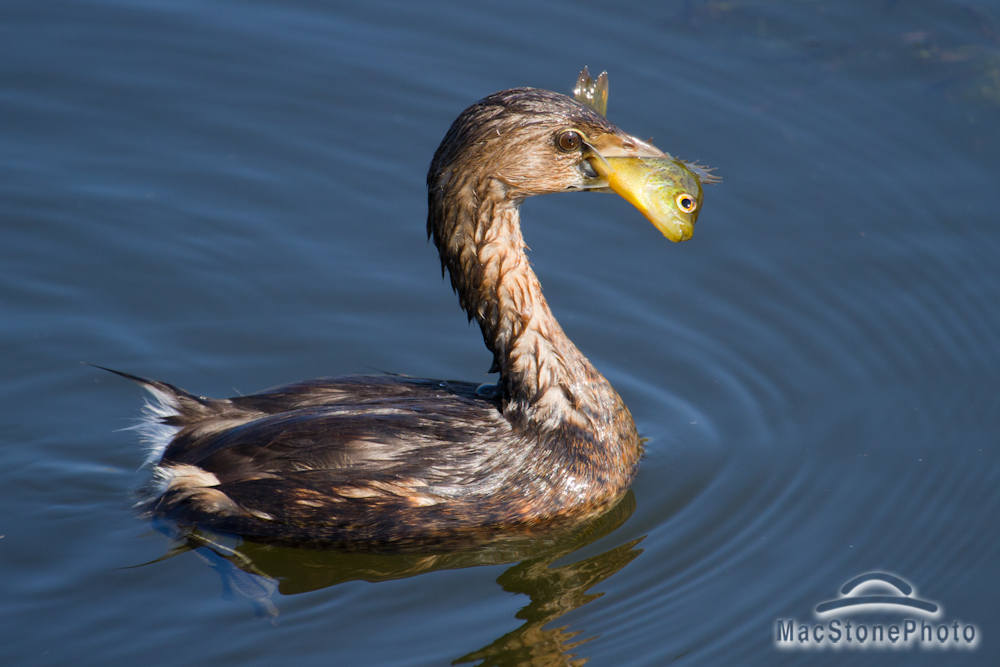


If you happen to be in South Florida or the Everglades during the dry season, I would say Anhinga Trail is a must-see. While it might not be the ideal place for peaceful solitude, it is the premier spot for close encounters with birds and alligators. Just make sure you park your car at the far end of the lot.
Field Work


Field work, with all its idiosyncrasies is difficult and demanding at times but the rewards are constant and overt. We traverse all kinds of environments and wilderness to get to our sites and I count on the fact that each day will be a new adventure with a new set of challenges. Just to give you an idea of what we go through, or rather, what we get to go through, I have compiled a video of outtakes from the field. Enjoy!
Fishing (not to be confused with catching)
I can’t think of anyone who took the cold snap this winter more personally than Pete Frezza. A widely published National Audubon biologist, the research manager at Tavernier Science Center, and reputable catch and release fly fishing guide, he has nurtured an intimate relationship with the Everglades and South Florida since high school. During the second week in January temperatures reached and sustained an all time low in the Florida Keys and Everglades National Park. The sudden freeze affected local fishing businesses, agricultural industries, and most notably, fish and wildlife within the Florida Bay and Everglades National Park area. For an entire month, dead fish, endangered American Crocodiles, turtles, and manatees continued to wash up on the shores. Although exact numbers are impossible to glean from such a large area, while accounting for variety of species scientists estimate the death toll in the hundreds of millions… Ahhem… That’s Hundreds of Millions.


All Access

Florida Bay and the Everglades National Park are huge places. For a novice, without the aid of topographical discontinuity or frequent trail markings, navigating through these areas is extremely difficult. The nondescript cuts and endless chains of mangrove islands help deter most people from venturing out alone. As menacing as the nautical maps may be, plenty of experienced anglers and explorers launch into the canals and blind turns of the backcountry.

Because it’s such a large area, it’s next to impossible for an underfunded park service crew to stay vigilant, especially on the fringes of the Everglades. As an avid trespasser myself, I fully understand the potential payoffs and risks that rest on the other side of an unguarded fence. In fact, many of my favorite images have roots that extend past legal property lines. My body follows my curiosity and my curiosity follows the blind theory that if there’s a fence, then generally speaking, something interesting, something forbidden, and eventually, something irresistible, rests on the other side. For the first time, however, legally, I have carte blanche to one of the most famous wildernesses in the world: Everglades National Park. I have to admit I miss the thrill of delinquency, but while in nature, the absence of adrenaline brings peace of mind, and peace of mind brings clarity, and clarity, for an artist, is a powerful tool.

Working with a reputable organization like Audubon in the Florida Keys parallels to having the golden ticket in Willy Wonka’s factory; instead of a river of chocolate we have endless estuaries, instead of fizzy lifting drinks, we have helicopters. I dug deep to find something that likened to an oompa loompa, but it would have been a stretch. I know it’s a ridiculous simile, but it’s hard not to feel like a kid in a candy shop out here.


Just before Christmas, I was invited to go out with Audubon’s bird crew to monitor and band nesting roseate spoonbills. Since my specific job with the fish crew requires that I be at our sample sites every day, this was an extremely rare opportunity to leave the nets behind and pick up some binoculars.

The spoonbill crew is responsible for finding and tagging nests all throughout the Florida Bay and into the southern tip of the Everglades. Most of the nesting sites have been protected and blocked off to human traffic in order to allow the birds a safe haven for nesting. Knowing that I would be walking through mangroves otherwise forbidden and unfamiliar to the general public was half the fun.


The most productive site for the spoonbills is Sandy Key. In a good season there can be anywhere from 100 to 300 nests. That number doesn’t include the egrets and cormorants who also nest on the island. This year, however, water levels are at an unusual high, which prevents the spoonbills from frequenting their favorite foraging grounds. Additionally burdened with a recent cold snap, spoonbills have a trying winter ahead of them.

Aside from the climate, the offspring face an array of obstacles. On some of the nesting sites, crocodiles and alligators wait patiently below for clumsy fledglings.


Despite the tough conditions, many spoonbills have tried valiantly to propagate the next generation. Sadly, some have failed.


Strangely, other adults in the same colony seem to be unaffected by the peripheral challenges.


Equipped with convex mirrors attached to painter’s poles and extension ladders, we scour the island for nests. Arching and bending beneath the mangroves’ brachial maze, we trip, slip, and slosh through the sediment and whitewashed roots like clumsy tourists. Well, at least that’s how I moved. Karen and Seth, the more experienced mangrove marauders, navigated far more gracefully.


When we found a nest with chicks old enough to receive bands, we set up the ladder and grabbing the largest bird first, we brought them down to the ground. Their blunt beaks were not quite hard enough to cause any discomfort but they had another, much more effective defense tactic. Upon lowering these guys to the ground their first reaction is to pooh everywhere; and not just a little dribble, but with an almost sniper-like accuracy. While extremely unpleasant it’s hard to hold a grudge against a terrified ball of pink feathers. Besides, I’m pretty sure I did the same thing as an infant, minus the accuracy.

Over time Audubon will monitor the birds’ progress and track their movements. This information will give us a better idea of the feeding and breeding habits of these beautiful birds and the legislative steps necessary for ensuring their future.
 Mac Stone Photography