
Savage Race – Little Everglades Ranch
Well, the boys at Savage Race have done it again. Each event has eclipsed the last and on October 20th at Little Everglades Ranch in Dade City, Florida, they proved to 4,000 adrenaline junkies that they’re the official peddlers of pain in the mud race community. In a span of only six miles they built 25 brutal obstacles including the three-story “Colossus,” a twisted half pipe which leads to a swallow-your-stomach water slide and the innovative “Evil Bars,” which is the silverback gorilla to other races’ playground jungle gyms.
 |
| Starting line stampede – Photo ©Savage Race/Mac Stone |
Again this year, I was assigned to shoot the race and was stoked to know the participants would be slogging through a mini version of my favorite stomping grounds, the Everglades. As always, it was a tough shoot accounting for a large area, harsh light, and of course, high intensity mud-slinging. All throughout the day I was climbing atop obstacles, chest-deep in water, or waist deep in mud. By the end I felt like I had run the race several times over.
 |
| Walkers on the “Nutt Smasher” – Photo ©Savage Race/Mac Stone |
My approach to shooting these events is to make sure I get right in the middle of the action, or sometimes right below it. I’ve found that if I’m not physically engaged with course, then my photos will feel detached too. This philosophy can be dangerous for equipment, but much like wildlife photography, the safest option usually produces “safe” images and the Savage Race crew wanted edgy. So I tried to give them edgy.
 |
| Diving over the fire pit – Photo ©Savage Race/Mac Stone |
Here’s a handful of some of my favorites from the day as well as a few shots just to show you some of the obstacles. If you’re into mud races and a day of fun with your friends, then you need to go and register for one of their upcoming events. Savage Race is creating the new standard for obstacle racing.
 |
| Starting line – Photo ©Savage Race/Mac Stone |
 |
| Hay Stacks – Photo ©Savage Race/Mac Stone |
 |
| Championing the Hay Stacks – Photo ©Savage Race/Mac Stone |
 |
| Captain America helping a friend up “Colossus” – Photo ©Savage Race/Mac Stone |
 |
| Nutt Smasher – Photo ©Savage Race/Mac Stone |
 |
| Not quite up the Colossus – Photo ©Savage Race/Mac Stone |
 |
| Grinding the Evil Bars – Photo ©Savage Race/Mac Stone |
 |
| Colossus half pipe – Photo ©Savage Race/Mac Stone |
 |
| Tazed N Blazed – Photo ©Savage Race/Mac Stone |
 |
| Gettin Tazed N Blazed – Photo ©Savage Race/Mac Stone |
 |
| Priceless face before getting shocked – Photo ©Savage Race/Mac Stone |
 |
| Fire jump – Photo ©Savage Race/Mac Stone |
 |
| Evil Bars – Photo ©Savage Race/Mac Stone |
 |
| Shriveled Richard – Photo ©Savage Race/Mac Stone |
 |
| Colossus – Photo ©Savage Race/Mac Stone |
 |
| Scaling the 96” Stiffie – Photo ©Savage Race/Mac Stone |
 |
| Nuff said – Photo ©Savage Race/Mac Stone |
 |
| Greg Stone hangin on the Evil Bars – Photo ©Savage Race/Mac Stone |
 |
| Davy Jones’ Locker – Photo ©Savage Race/Mac Stone |
 |
| Backflip off Davy Jones’ Locker – Photo ©Savage Race/Mac Stone |
 |
| Savage Race founder Sam Abbitt trying his Wicked Bars – Photo ©Savage Race/Mac Stone |
 |
| Air Force team looking for their keys – Photo ©Savage Race/Mac Stone |
And my favorite photo of the race: the Air Force team breaking into their own car to get their keys out.
Get Low
 |
| “Edge of the World” – Florida Bay – Everglades National Park |


Pretty in Pink
The spoonbill saga continues. I just went down to the Keys for a week to train the new head of spoonbill research at the Tavernier Science Center. When I walked in the office, Dr. Jerry Lorenz handed me a book from Bearport Publishing. I completely forgot I submitted images nearly 6 months ago on this project and here it was, printed, bound, and ready for distribution.

The author, Stephen Person, contacted me early this year to help collaborate on a children’s book about the roseate spoonbill and the work we did with National Audubon and the Tavernier Science Center. Jerry helped with the text and while it has the illustrative feel and design of a children’s book, it’s actually incredibly informative about the Everglades ecosystem and the lives of these beautiful birds. If you have a child who needs a good book this Christmas, give this one a shot. You can tell them you know one of the photographers!
You can find it here on Amazon: Roseate Spoonbill, Pretty in Pink
Love for the Swamp
 |
For those of you that missed it in the bookstores, BBC Wildlife Magazine did a 13-page feature portfolio on my work in America’s Swamps. This was pretty exciting for me as a photographer, but especially significant from a wetland conservationist standpoint. We’re finally getting swamps some positive PR!
The BBC staff are top notch. They’re extremely thorough, inquisitive, and insightful; so when I was going back and forth with them about the layout and captions, it was a surprisingly painless process. The only complaint that they expressed was not having enough pages for the images I submitted. Can’t get better feedback than that!
If you’d like to check out the actual portfolio complete with captions in PDF version: Click Here
Or, you can find the online gallery of some of these photos here: America’s Swamps
Florida Wildlife Corridor Expedition
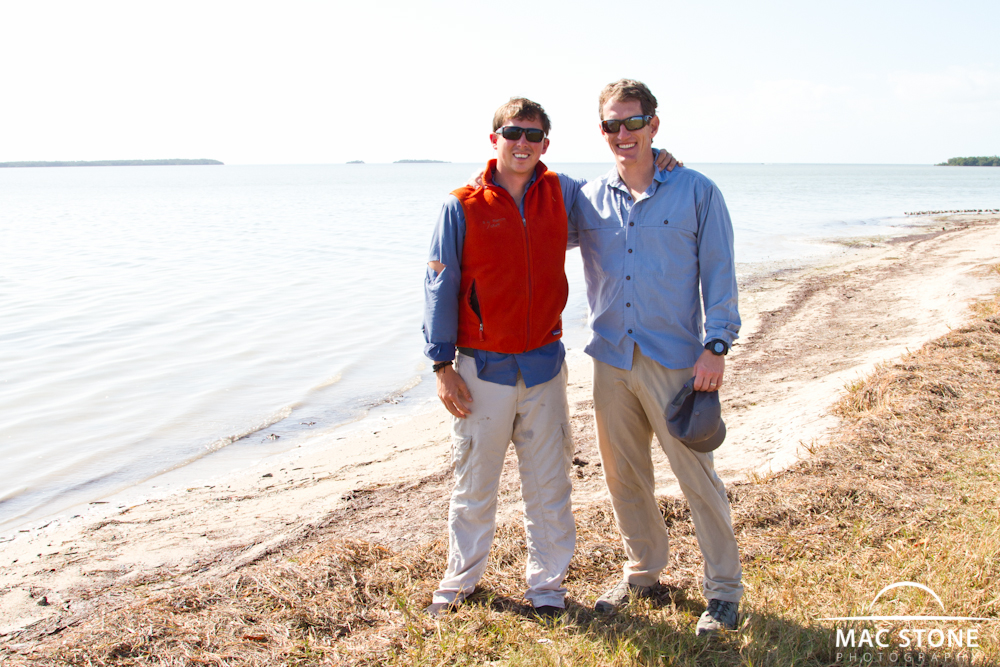 |
| Me with Carlton on the morning of their departure from Florida Bay |
I was there for the first day of the expedition when Carlton Ward Jr, Mallory Lykes Dimmit, Joe Guthrie, and Elam Stoltzfus set out on their 100 day/1,000 mile journey from Florida Bay to Okeefenokee Swamp. I remember feeling a palpable envy knowing that they would be crossing some of the most wild and scenic regions of Florida. The simple idea of traveling 1,000 miles by your own sweat and grit, without the aid of pavement, is a crazy one by most standards. But crazy ideas and groundbreaking efforts are usually what it takes to move mountains. And if Florida is going to provide a corridor stretching from the Everglades to Georgia for endangered wildlife like panthers and black bears, well, some mountains will need to be moved.
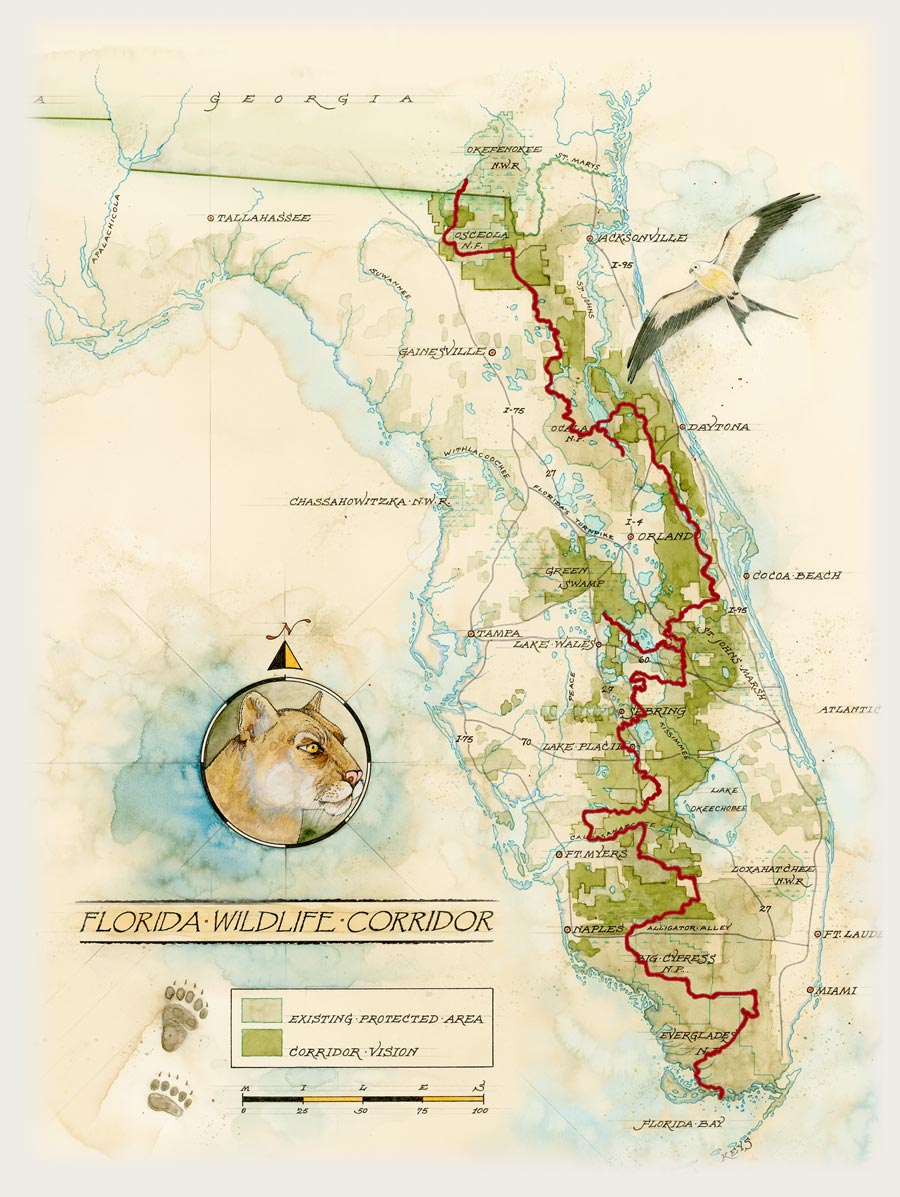 |
| Florida Wildlife Corridor Expedition map |
I planned on meeting up with Carlton and the crew along several stops of their journey but never found the time as I was wrapped up in my own adventures. When Carlton called me to come and join them on the final stretch through Okeefenokee Swamp, no matter what it was going to take, I knew I had to go. Having photographed his group for 100 days, it turned out no one had really taken images of Carlton, so it was my job to capture the essence of the group as a whole as well as its fearless leader. I felt a little like Nick Nichols on expedition with Mike Fay in the African Congo Megatransect, a story that I drooled over when it was published in National Geographic in 2001.
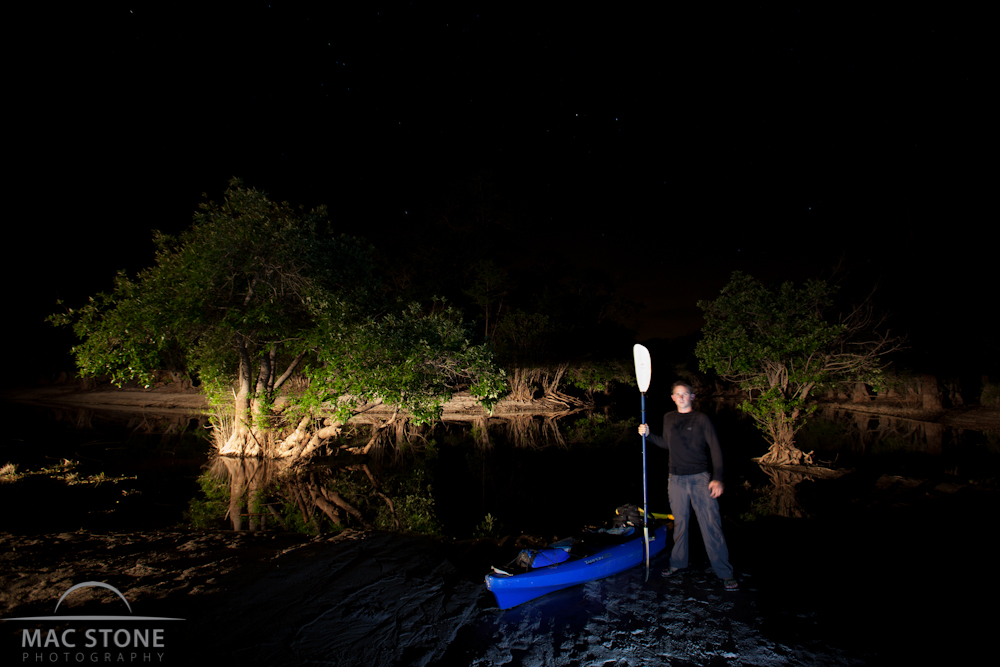 |
| The headlights of my truck offer a quick photo opportunity before taking off on the Suwannee River |
When I pulled into Griffis Fish Camp, it was 11:30 PM. There was no moon, just stars and a cacophony of frogs and toads. I had no idea where the expedition team was, just a general sense that they’d be South on the Suwanee River somewhere, camped along the banks. Carlton said he would leave a fire burning but that was at 9:00. I considered camping at the fish camp but knew that I needed early light photos of the group so I bit the bullet and paddled out into the darkness. My headlamp ruined my night vision so I turned it off and hoped for the best. Of all the things that could have scared me, the worst thing on the water at night were the wood ducks. It seemed they waited until they were right next to my boat when they would explode off the water. I felt so foolish when my nerves calmed. Finally, I pulled my kayak into camp around 1:30 and set up a tent, without so much of a stir from the team.
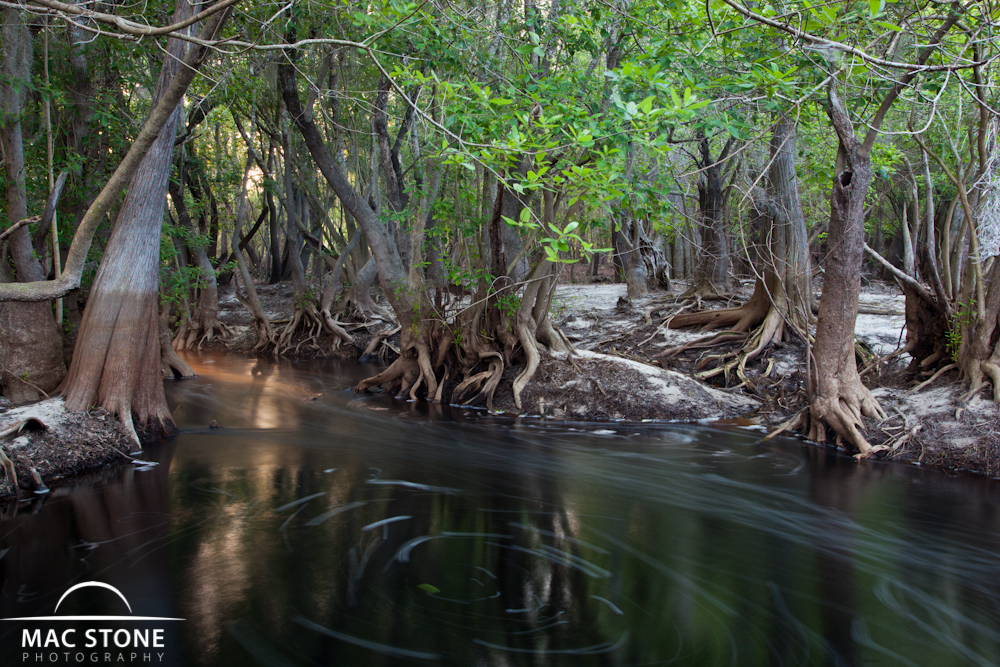
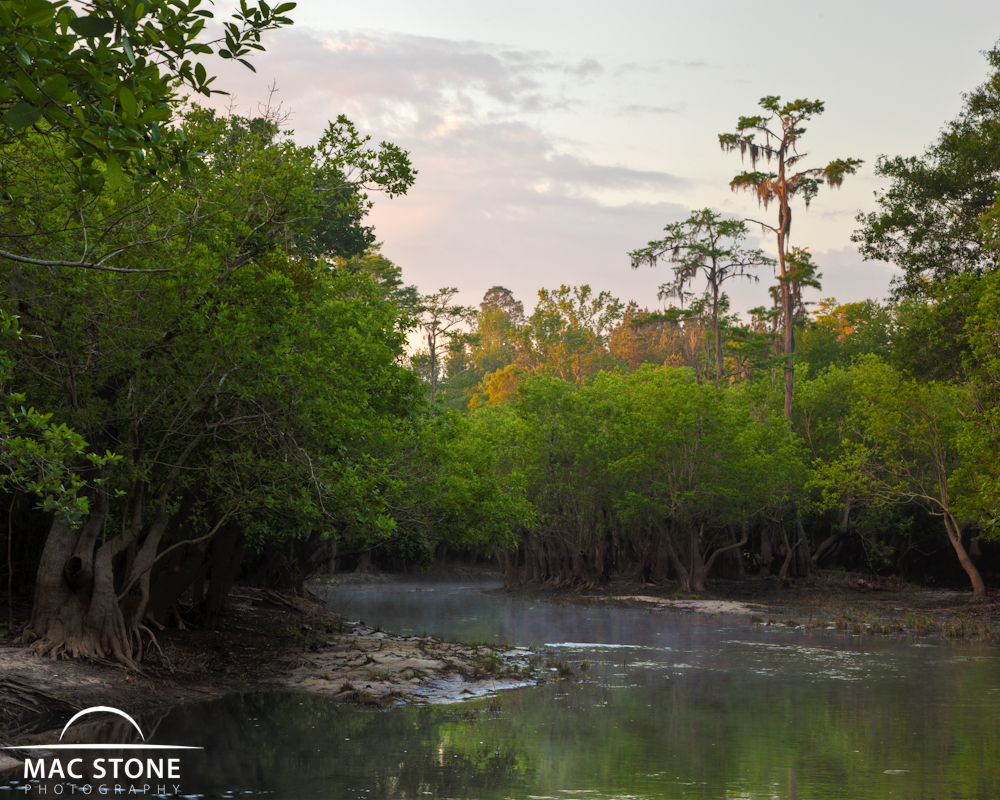 I woke the next morning at 5:30 to ready my camera gear and head out on the river for first light with Carlton. Polar fog was settling on the water and made for some great images with the looming tupelo and cypress along the banks. Carlton and I paddled upstream while the rest of the crew prepared breakfast and packed their tents. Photo shoots like these are tough. Since I didn’t have any time the day before to scout locations I had to work quickly to find compositions and opportunities where the light allowed. Luckily I was able to make a few frames before the fog lifted while gentle amber light still dappled the tops of the trees.
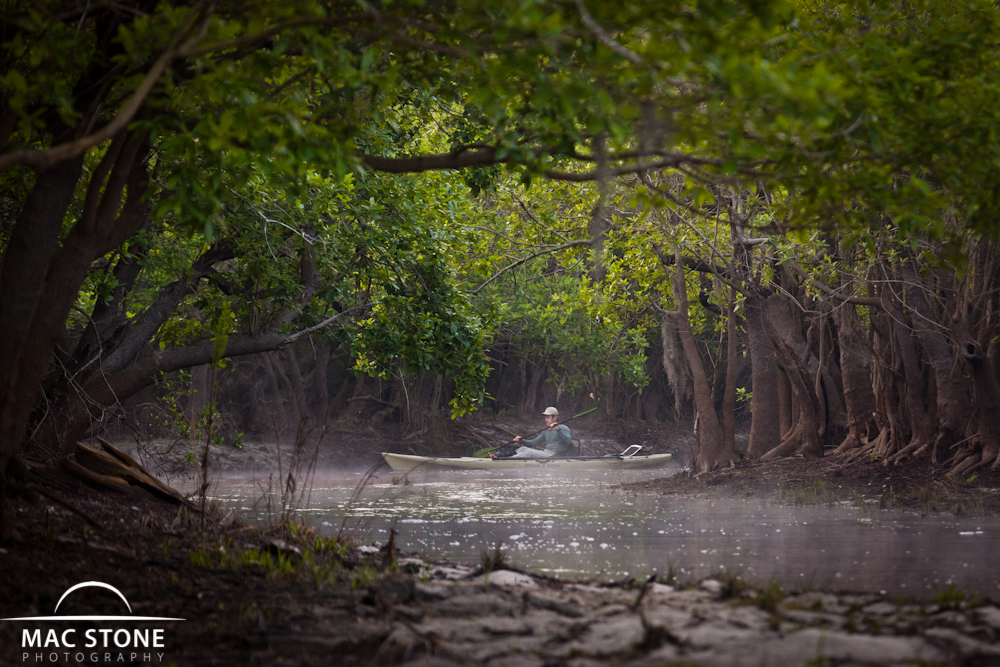
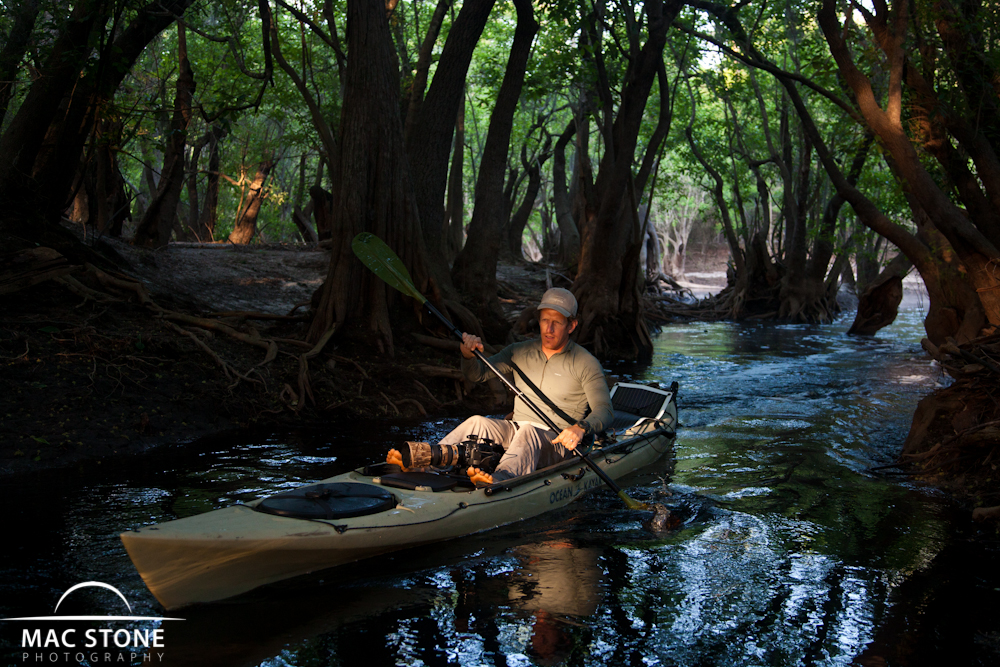
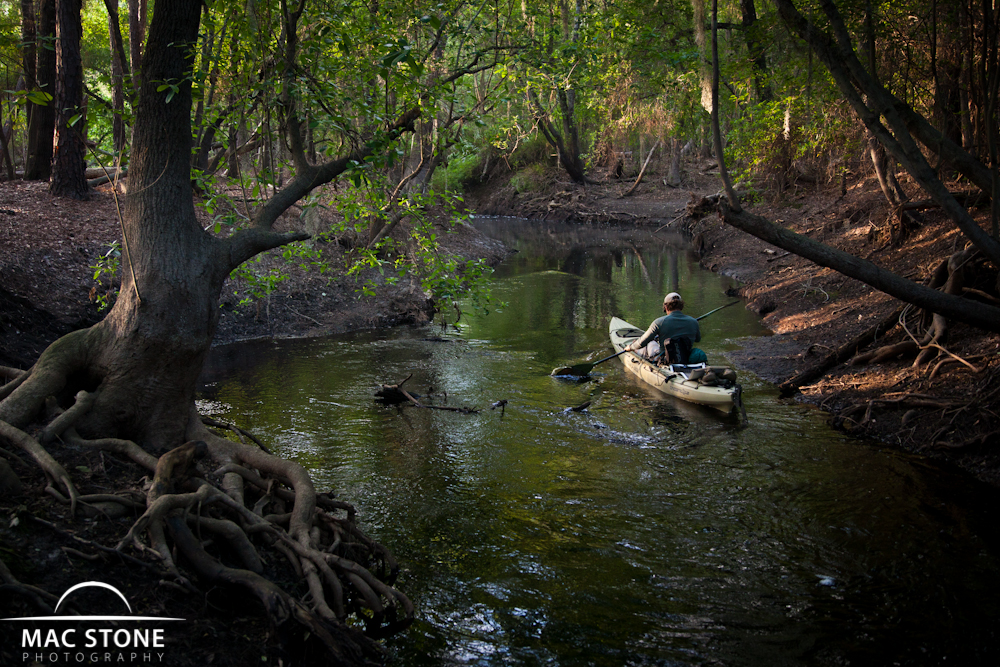
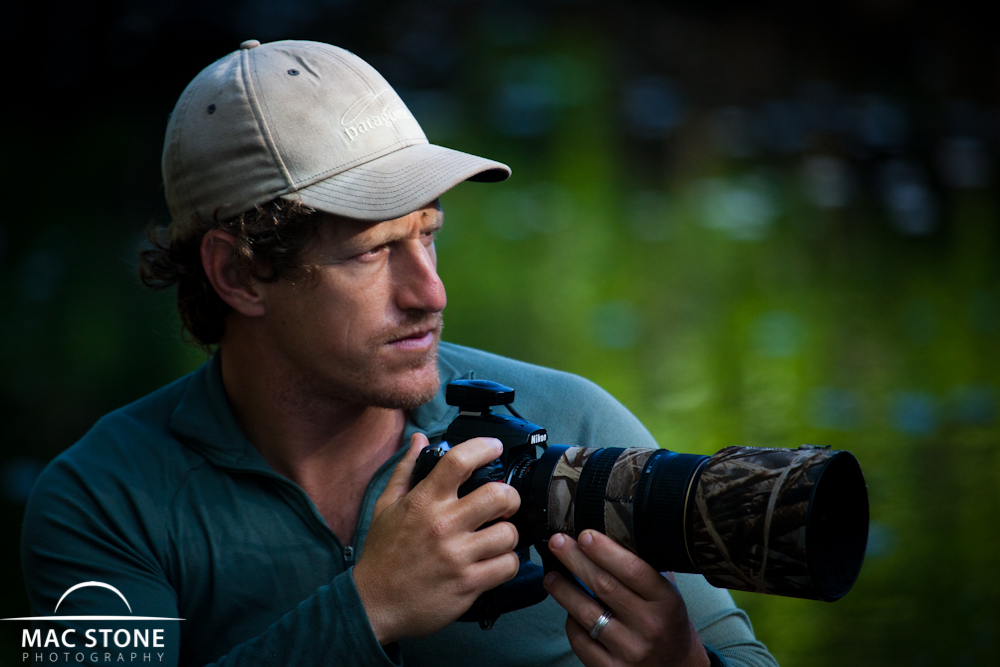
It’s an awkward thing being the subject of a photo, especially if you’re a photographer. All my friends will tell you the same thing as I constantly ask them to hold poses or look wantonly away from the lens. I think my girlfriend fears going out on hiking trips with me specifically for this reason. Carlton mused that he had never been in front of a camera so much as that morning with me. What can I say though? It was my job! I wasn’t going to let embarrassment or a small thing like courtesy get in the way of my images, I mean, do you think Nick Nichols would ever bashfully put away his camera with light like this? I don’t think so.
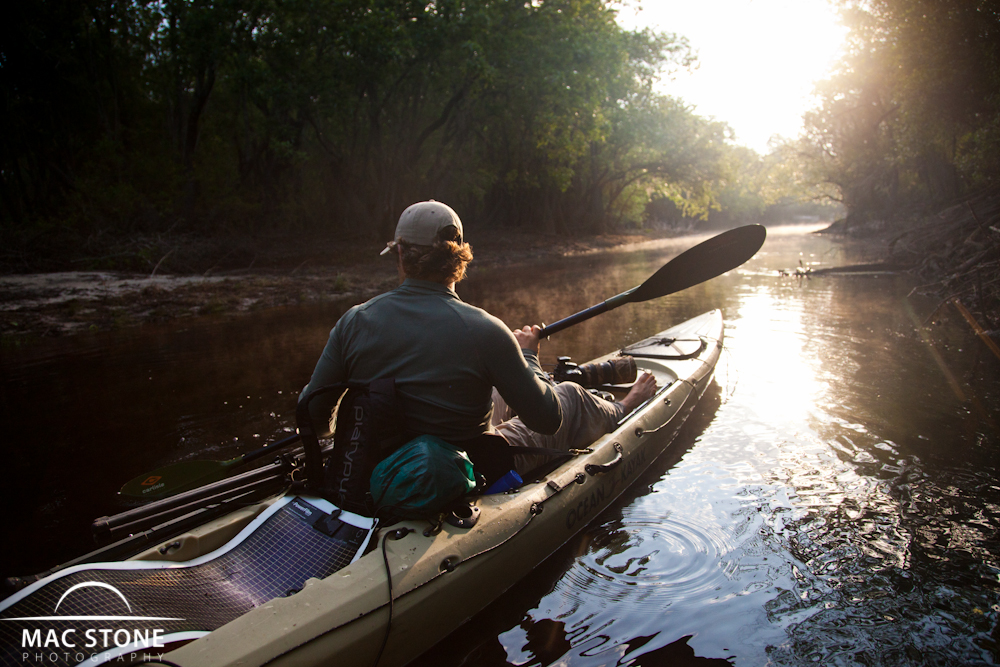
As soon as the sun started heating up the water, the light became too harsh and we pushed back to the camp to make moves for our lunch break at Griffis Fish Camp. It wasn’t until we were halfway there when Carlton told me we were actually stopping to meet up with Mike Fay, THE Mike Fay, who flew in from Washington to also join in on the last push of the expedition. (!!!!!!) Carlton had met Mike while photographing in Gabon and invited him to serve as the ultimate transect guru and guest speaker for their final arrival on Earth Day. If there’s anyone on this planet who knows about major transects to protect land, Mike is the authority.
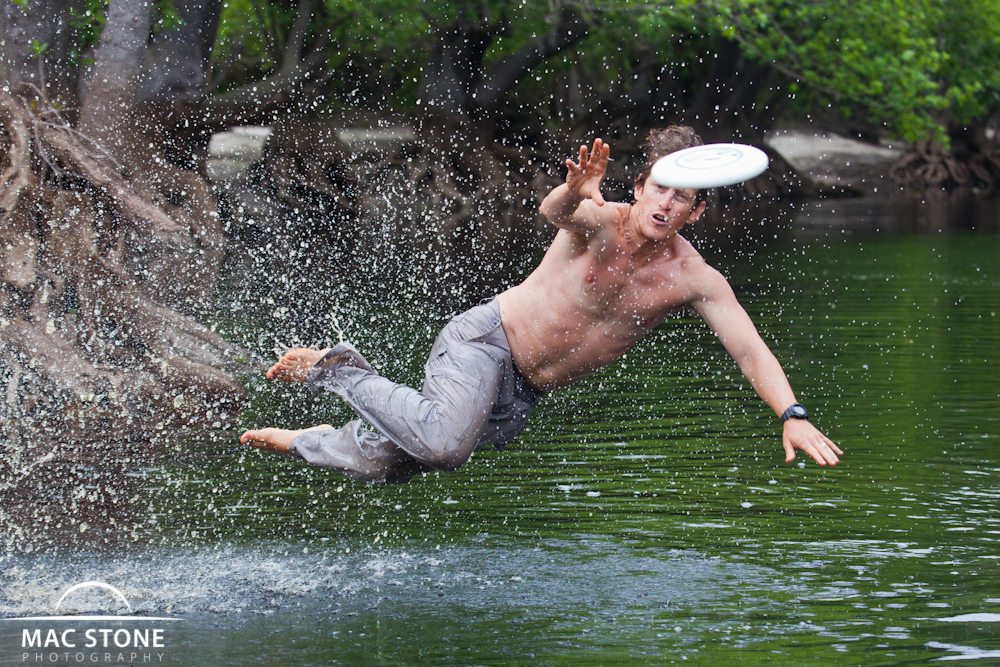 |
| Carlton Ward gets horizontal for a frisbee |
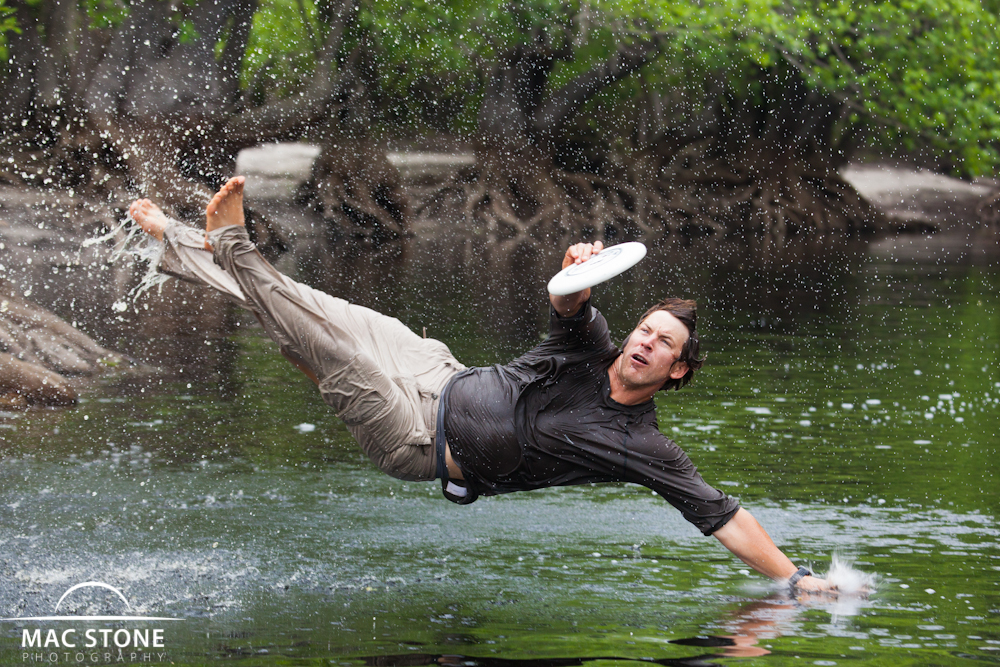 |
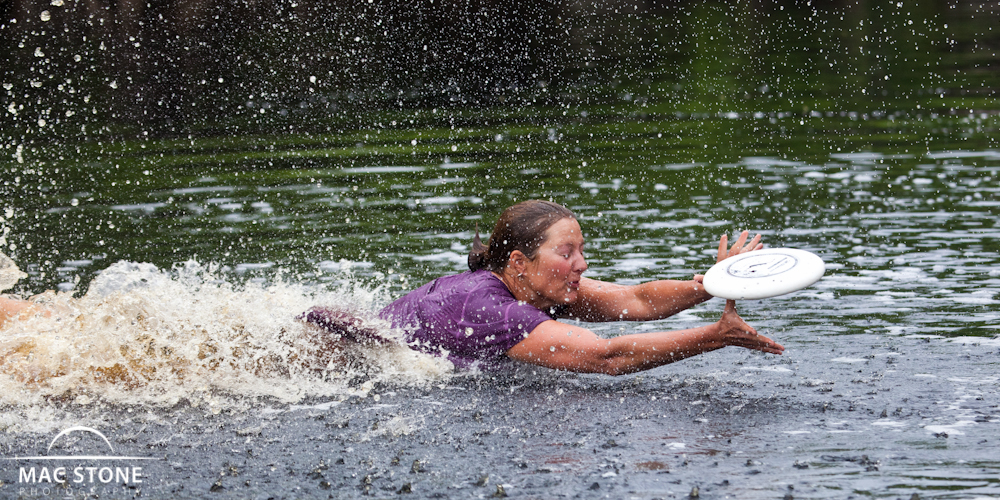
| Joe Guthrie lays out for a disc on the Suwannee River |
 |
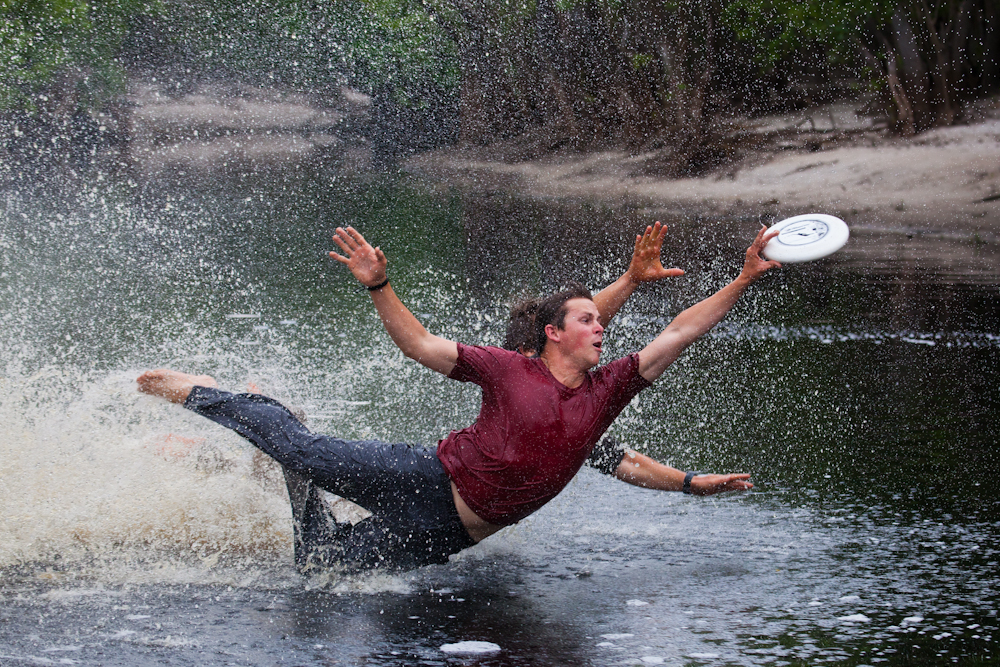
| Mallory Dimmit dives for a frisbee |
 |
| It didn’t take long until we turned it into a frisbee battle, of course I’ll only show you the one where I caught it…
While we waited for Mike at the fish camp, I ran to my truck and grabbed a frisbee and we took turns running full speed into the river for full-on layouts. Good ol Florida backwoods fun. It turns out I’m not the only one who thinks this is one of the most entertaining things in the world. Eventually Mike showed up, and like a bunch of crazed labradors, dripping wet and panting we collected ourselves and made our introductions. All I could manage to say was a fumbling, “Hi Mike, uhh.. I’m a huge fan … umm I can’t wait to take photos of you.” Nothing says creepy quite like an overly sweaty, huffing, red-cheeked man with a camera.
|
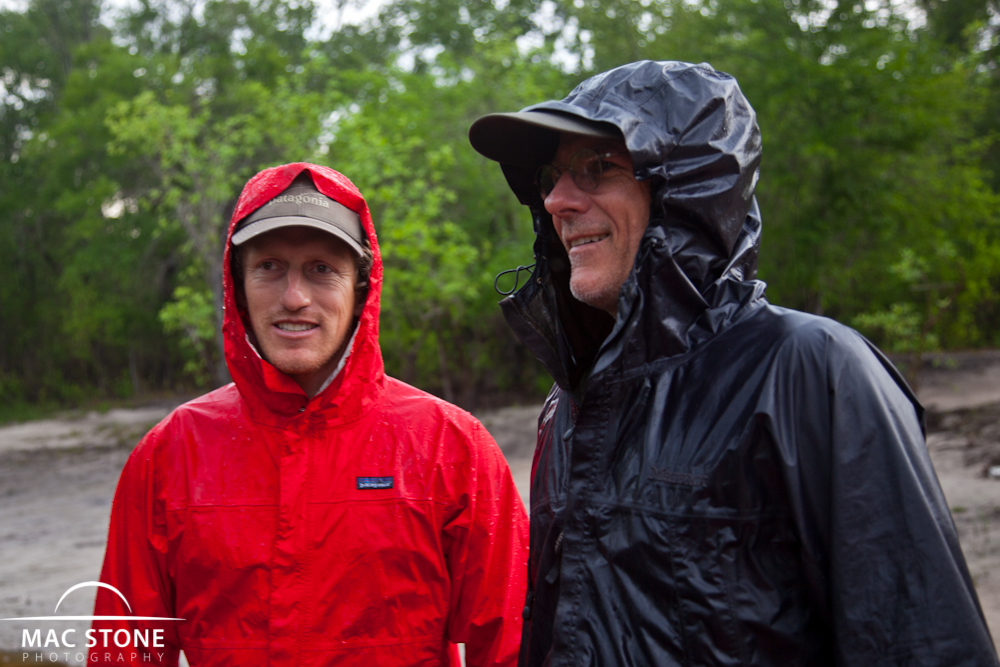 |
| Carlton Ward and Mike Fay meet up on the Suwannee River to finish the last miles of the expedition together |
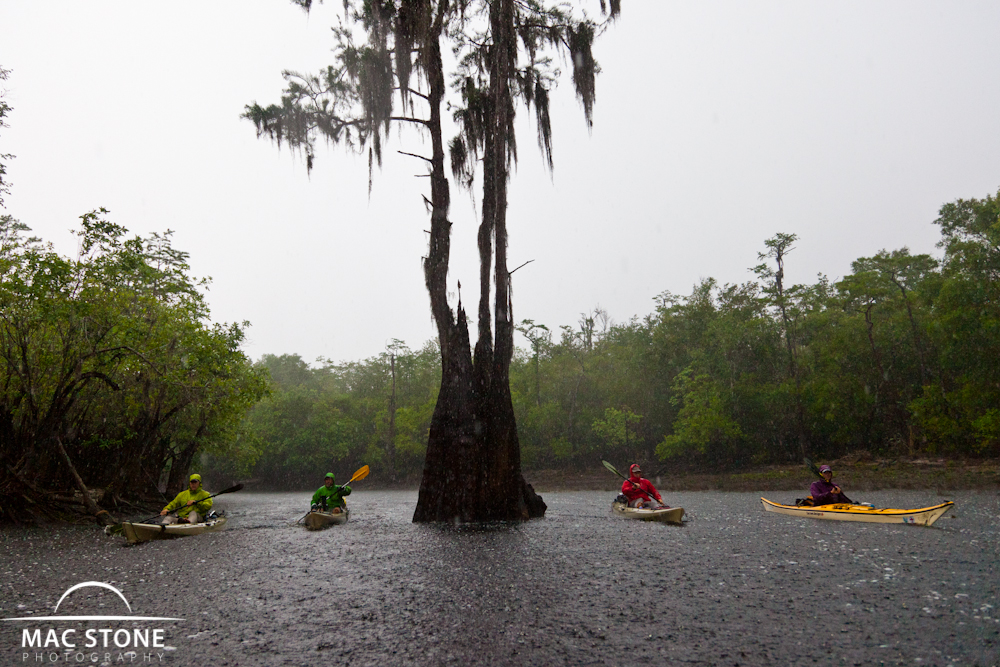
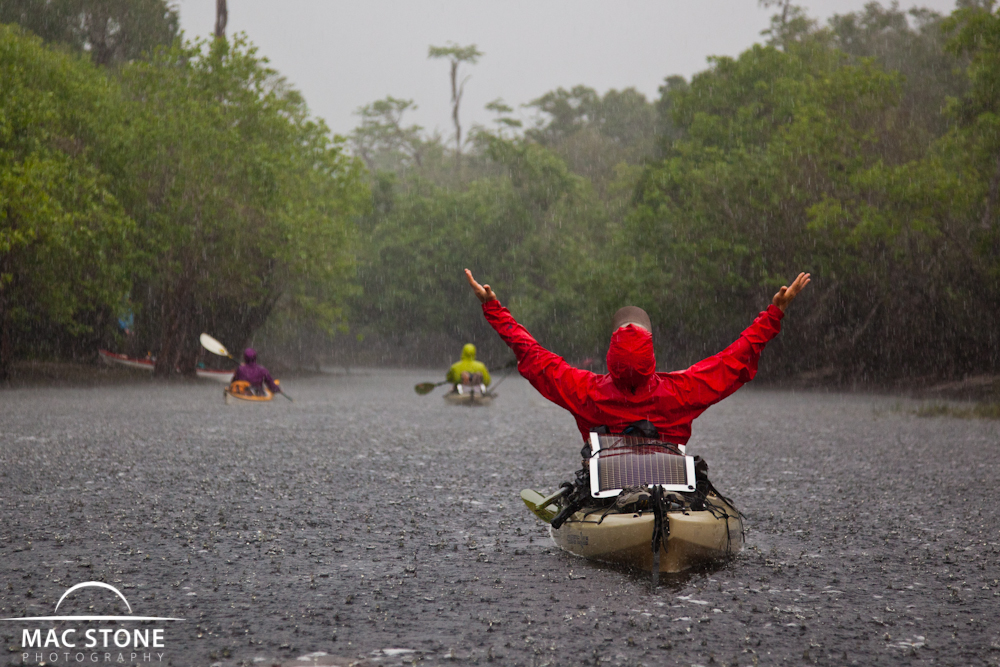
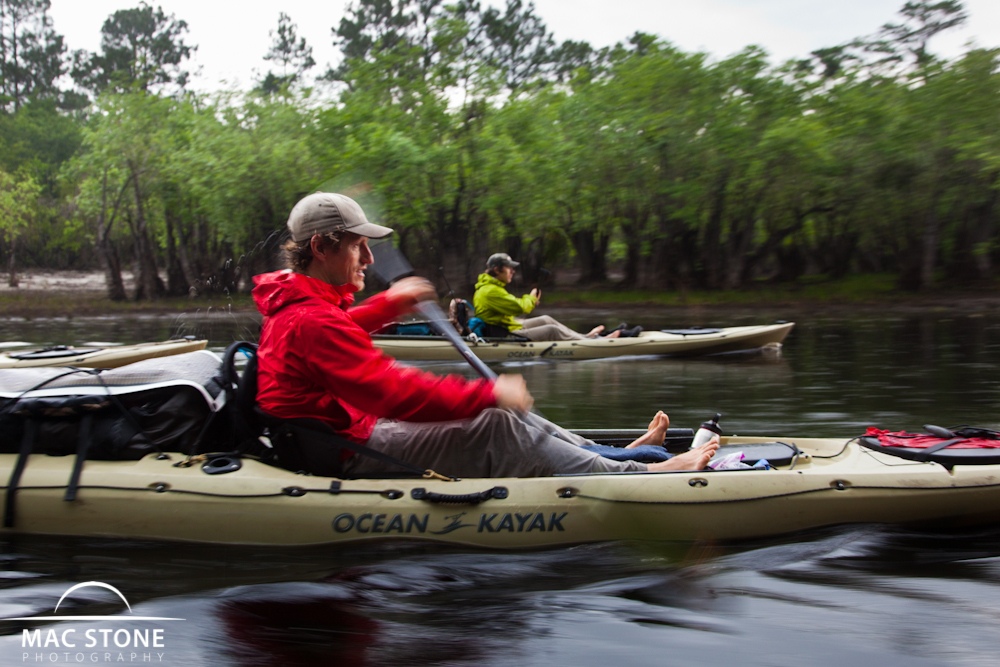
But there we were, all paddling up the Suwannee River into Okeefenokee National Wildlife Refuge and I couldn’t have been happier. Two of my conservation heroes on either side and a darkening sky with promises of thick heavy rain. If I were going to make this look like a hardcore expedition it couldn’t be all sunshine and rainbows. Luckily I packed a large golf umbrella on my kayak specifically for shooting in these conditions and when the skies opened up, I was ready.
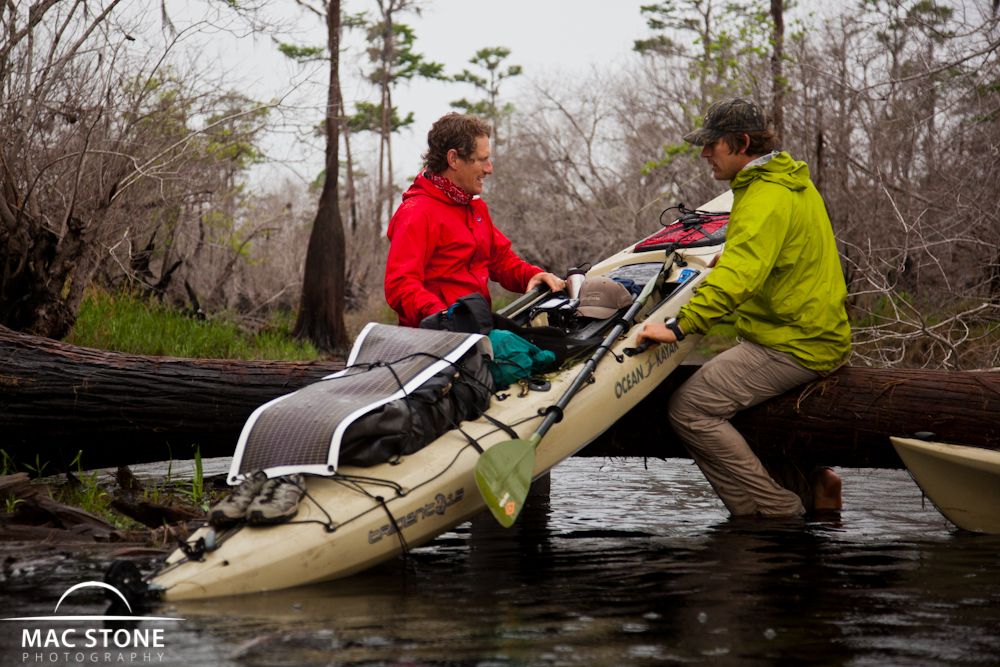 |
| Carlton and Joe G. portage over a fallen log |
Once the storm passed the Okeefenokee came alive. Prothonotary warblers echoed in the canopy and the lush swamp started closing in around the river. The Suwannee soon turned into a series of braided creeks and diffuse wetland. Trees had fallen across the water and we were forced to make a few precarious portages over the slippery logs. This was all pretty standard procedure to Carlton and Joe, who had seen their fair share of obstacles along the trek. There’s no such thing as an easy path along 1,000 miles of wilderness.
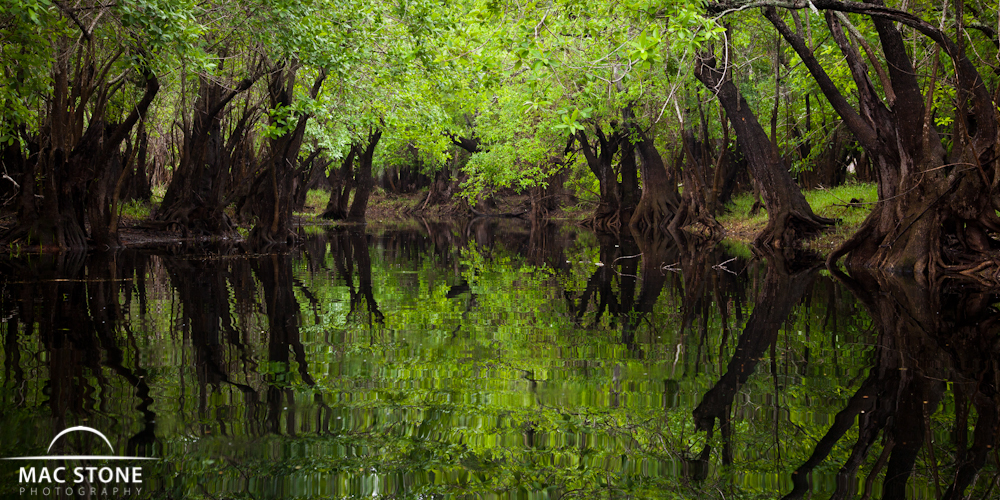
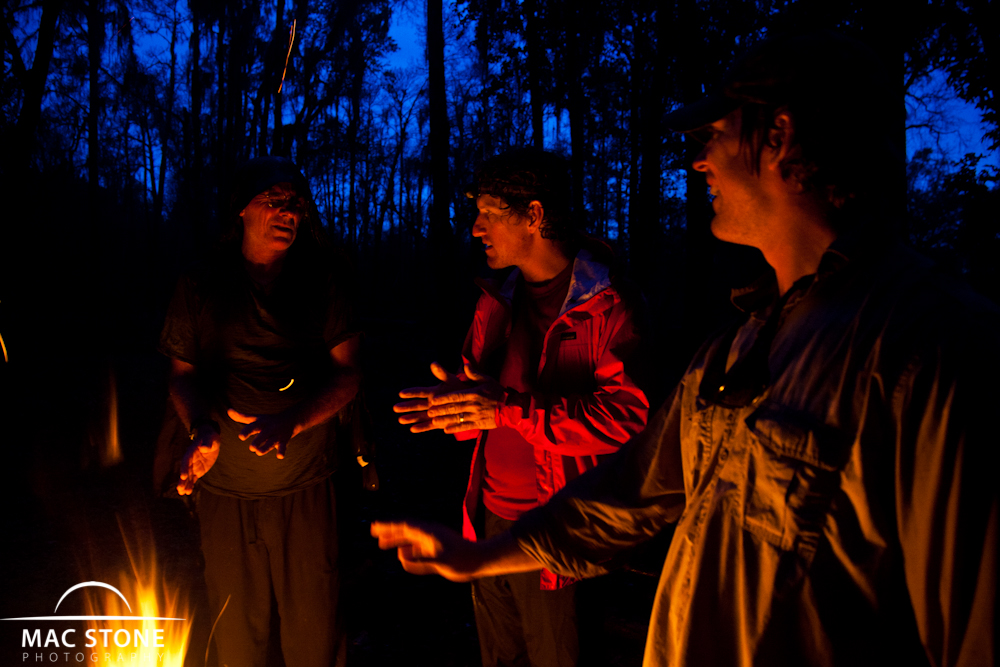
By the time we made it to our campsite, we were soaked to the bone. The rain picked up again and wouldn’t relent. All my camera gear was wet and I wasn’t looking forward to spending the night in a puddle. Not that I had much choice though and plus, I wouldn’t dare voice any complaint, not while in the presence of Mike who battled nearly every single discomfort known to man on his various transects. The chances for a fire were grim, until Joe found his axe and started to chop at burnt pine revealing lighter’d (lighter wood). We used my jet boil to get the coals going and soon enough we were warming up around a roaring campfire. Sweet, sweet, bliss.
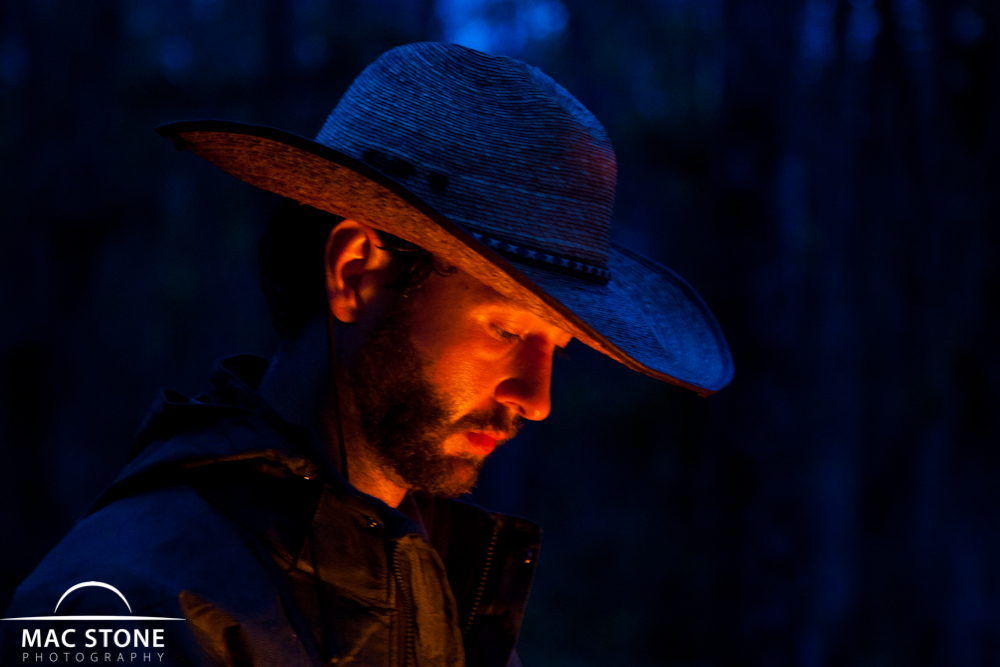 |
| Joe Davenport warms himself by the fire |
Around the fire we talked shop all night, discussing gear preferences, cameras, and favorite whiskeys. It didn’t take us long to finish the Maker’s Mark I brought either, giving us that extra warmth before heading to bed. I’m sure for Carlton, Joe, Elam, and Mallory, they feared the fading light of the campfire as much as they welcomed their warm sleeping bags. With the dawn would come an end, a bittersweet finale to an incredible journey. For a crew that’s been shoulder to shoulder for 100 days braving some of Florida’s wildest places I could see how the finish line might actually be a daunting thing.
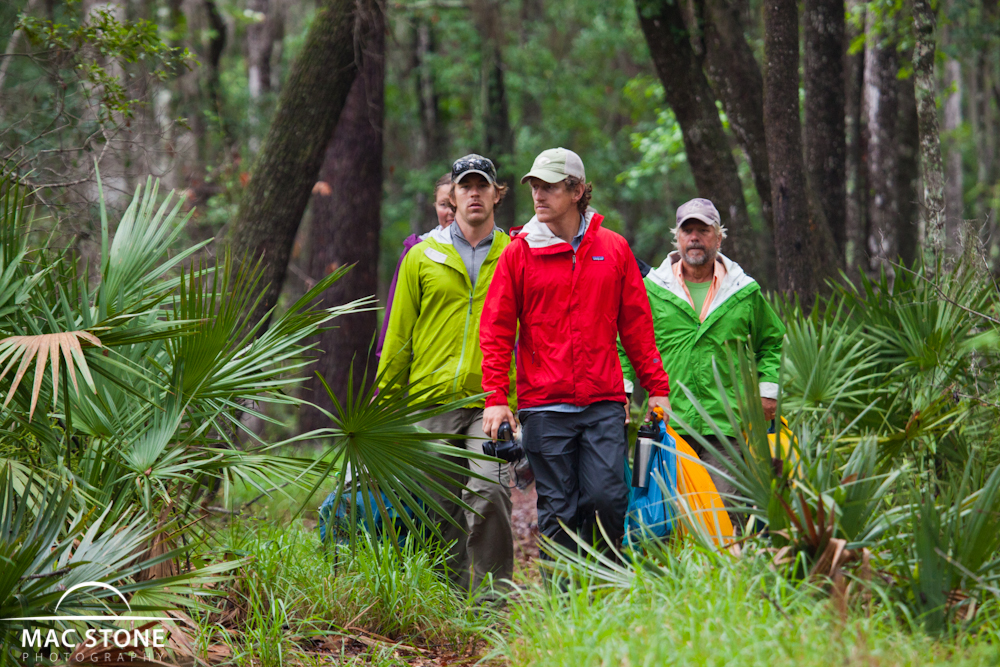 |
| From left, Mallory, Joe, Carlton, and Elam leave their campsite in Okeefenokee and make way for Steven Foster. |
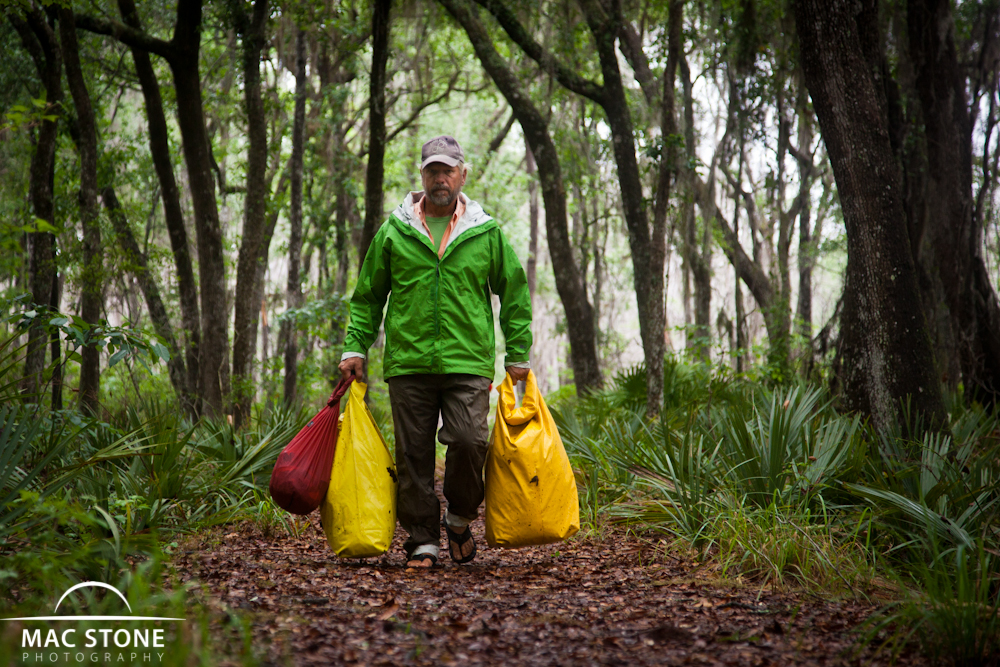 |
| Elam carries his bags to the boat |
After packing up, the group solemnly made their way to the kayaks. With only a couple miles between them and their welcoming committee at Stephen Foster, they took their time enjoying breakfast and drinking coffee. By 10:00 AM they were on the water and heading for the final stretch. Once momentum picked up and paddles were put to water, the group moved with lifted spirits.
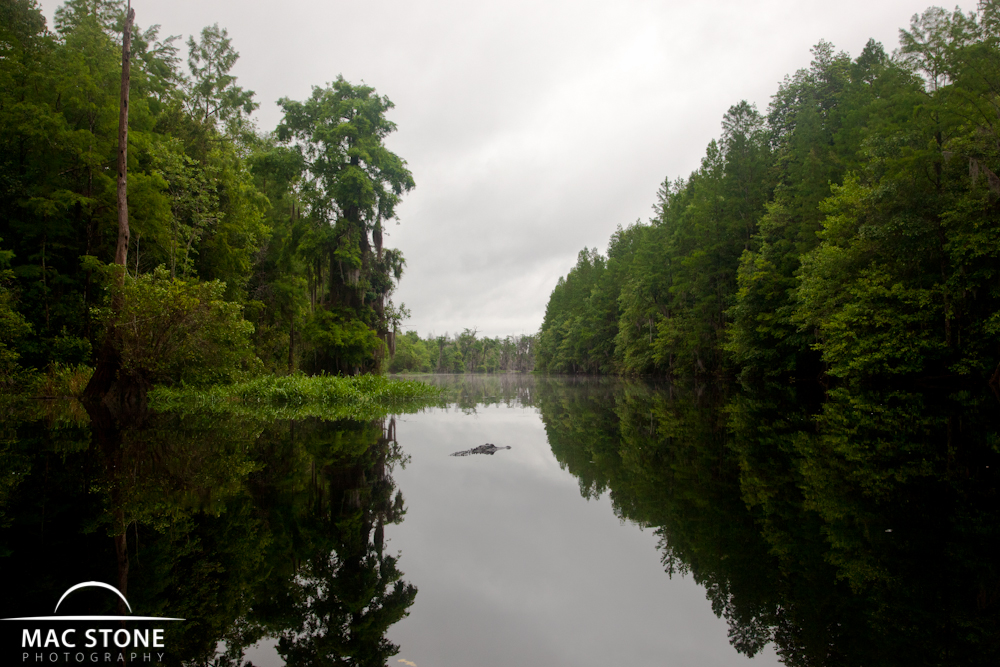
Alligators and warblers traversed the calm river and our kayaks cut through the mirrored landscape. By 12:00 we were at the mouth of the canal leading to Stephen Foster State Park and the rain let loose from the sky again. It was a fitting end; one last push through Florida’s fickle weather to the crowds of media teams and adoring supporters.
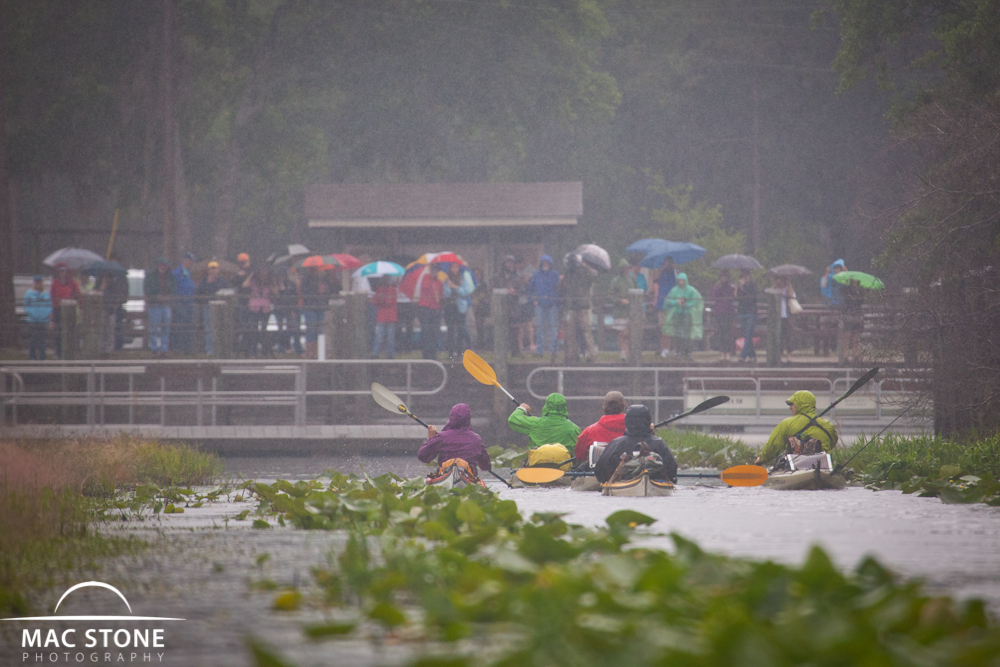
Their arrival was well-received and people cheered as Elam, Mallory, Joe, and Carlton disembarked from their vessels. Wives, brothers, sisters, children, and daughters swarmed the expedition team with tears and warm embraces. After 100 days and 1000 miles, they finally made it home.

Spoonbill Monitoring: Central Everglades

While my work generally has me boating and paddling around Florida Bay and the Southern Everglades, the Tavernier Science Center also works closely with the district throughout South Florida. This relationship ensures that we have a comprehensive data set for roseate spoonbills and other wading birds nesting all along the River of Grass watershed. Since nesting starts later the farther North you go, I was invited with coworker Adam Chasey in early March to accompany Robin Bennet and Mark Cook on an aerial survey of bird colonies in the water conservation areas.

We left out of West Palm Beach and flew over the sprawling city. It looked so alien on the fringe of such a subtle environment.

 You all know by now how I am on small airplanes so I was relieved to learn we’d be flying in style; a 407 helicopter, which is one of the smoothest rides out there. A few weeks prior I tried to access these colonies by airboat with University of Florida biologists, but failed miserably when our vessel got stuck in the dense sawgrass and cattails. That’s another story though.

Our main goal was to get spoonbill counts and see if we could spot bands which would tell us if our birds from the Bay were moving north to find other suitable nesting grounds. This turned out to be a tall order, however, as we learned the hard way. I thought that with a helicopter we’d be able to set down and explore the colonies on foot to find nests and adults within a photographable distance. What we learned after walking 30 feet into the waist-deep mire revealed that these tree islands are far different from the mangrove islands on the Bay. Too easily turned around and unable to see above the sawgrass which lacerated our arms and legs, Adam and I returned to the helicopter and attempted to photograph spoonbills from the air.

Thanks to our phenomenal pilot, Jake Wells, we were able to fly wing to wing with a small group and in no time, spotted our first band! For someone who spends most of his days looking up at spoonbills soaring across a blue sky, my heart melted as I flew side by side with these pink beauties. What an experience and better yet, what great data!
Loxahatchee River

There are only two rivers that flow freely into Lake Okeechobee, Fisheating Creek is one, and the Loxahatchee is the other. Before we started replacing our natural waterways with canals, Floridian creeks and rivers had personality, a sinuosity marked by thousand-year hardwoods and abundant wildlife. For this reason, unaltered rivers like the Loxahatchee are our best windows into the past. Early this month I had the unique opportunity to spend two days camping on the river while conducting spoonbill research via helicopters in the central Everglades. Fortunately, Adam Chasey and I met up with Radio Green Earth host Jim Jackson and Albrey Arrington, the Chief Executive of the Loxahatchee River District to learn more about the area and its role in Everglades Restoration. You can hear some clips of the recorded show in the podcast section here: RadioGreenEarth.org

I always wanted to put a paddle in the famed Loxahatchee. Its century-old cypress and winding blackwater gives it the title “Florida’s most scenic river.” Surprisingly it’s relatively unpopulated even on a weekend. When Adam and I were launching our canoe a couple came over to us and asked how we found out about the river, as if it were a local secret. I love places like this!

Our first day on the river we paddled a little over two miles in 4 hours. Not because it was a difficult paddle, but because it was difficult to stay in the boat and stop exploring the high banks studded with twisted cypress knees. On a branch not more than ten feet off the water a pair of barred owls preened and flirted paying us no attention.

Palms hung over the river, so of course we had to see who would be daring enough to walk across, which then promptly turned into a game of chicken, “who can go no hands… upsidedown?” This is my kind of swampin… I can’t wait to go back!
American Crocodiles:
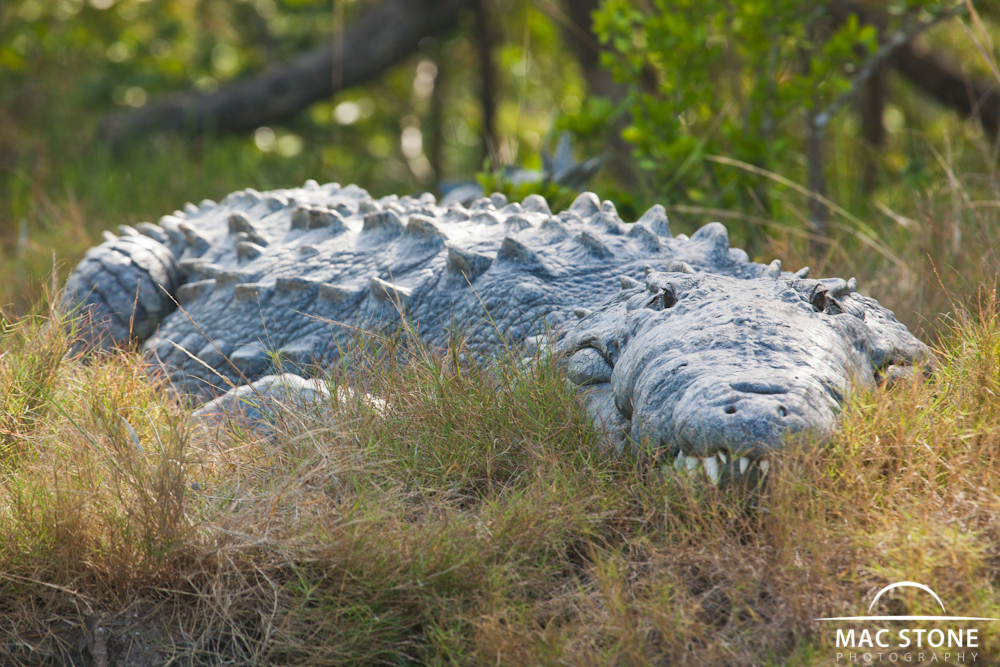
American crocodiles are probably my favorite animal in the Everglades. I grew up with alligators, played tag with their tails, swam with them, and even caught a few (all of which I would never condone). They’re a dime a dozen in most Florida waterways. Everglades National Park, however, is the only place in the world where alligators and crocodiles share the same space. Double bonus! I’ve photographed alligators so many times that I’m constantly trying to find new ways of photographing them.
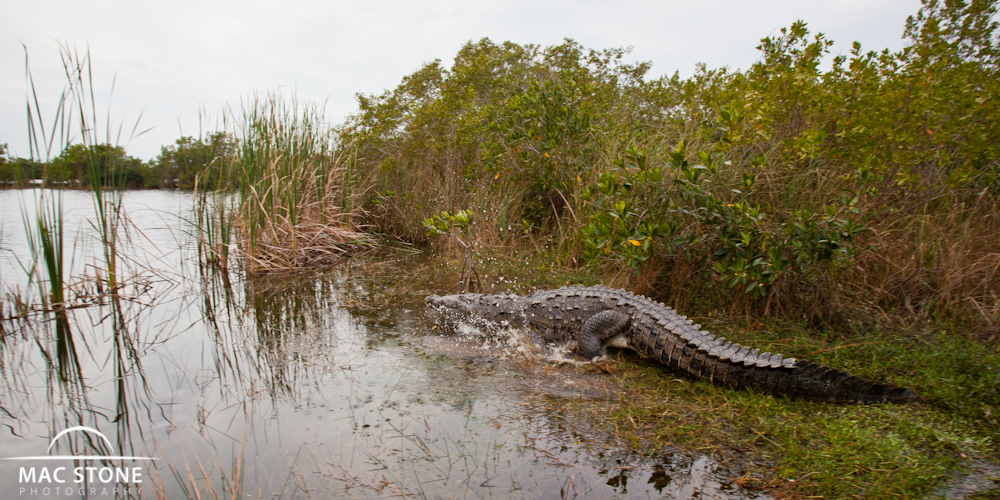
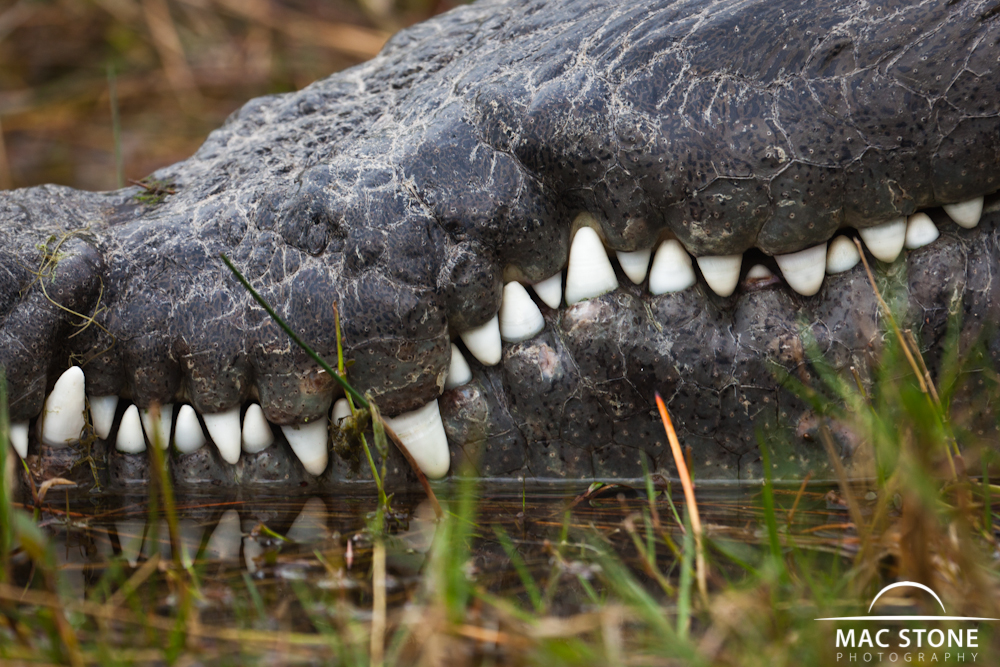 Crocodiles, however, are completely different beasts. In the United States they are considered endangered species and estimates range from 2,000-3,500 individuals. Besides the physical differences (longer snout, more abrupt scales, coloration, eye color, and jaw line), American crocodiles seem to have little in common with the alligators I came to know as a kid. While their gaze and exposed teeth are more menacing, they’re actually incredibly shy and tough to approach. I’ve tried for nearly two years to capture a worthy image of these reptiles without much luck. It always seems that just as I am closing in with good light and camera ready, they scuttle off into the murky water. I do, however, have plenty of images of a giant splashing tail.
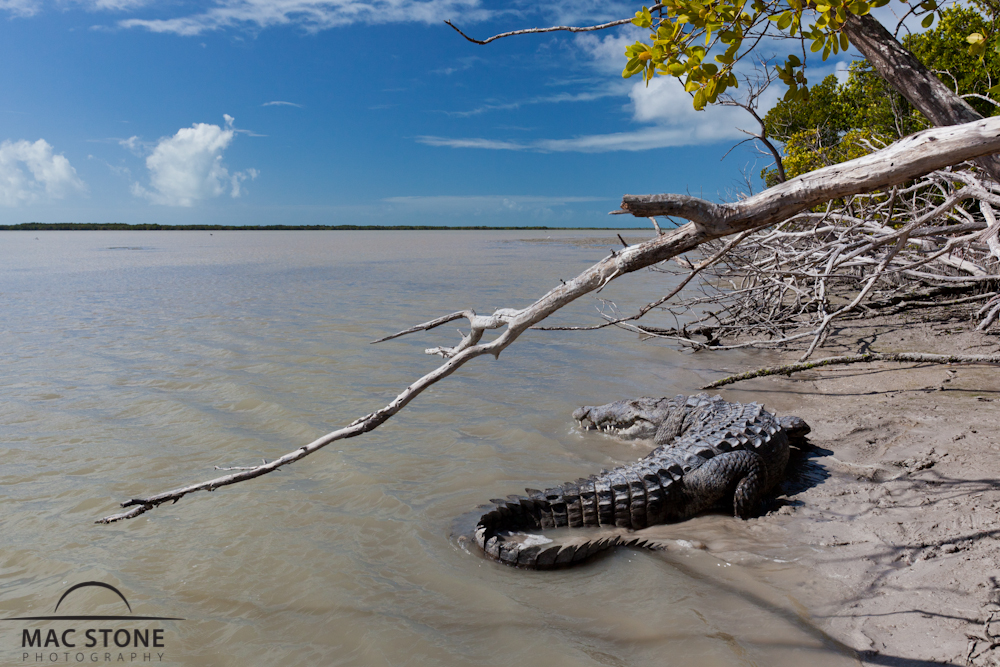
I embrace these types of challenges, though. The trick to any wildlife photography is figuring out the animal’s habits and then putting yourself right in the middle of it. Reptiles are fairly predictable creatures. Knowing that above all else they need to warm their bodies by sunlight, I tried a technique I employed while in South Carolina. Setting my camera trap up at one of their favorite basking locations I let the shutter run for three days at 2 minute intervals. I was disappointed not to find a single crocodile when I returned to retrieve the camera but they simply have too many places they frequent to depend on one location with a static, un-manned camera. I needed a bottleneck; some sort of biotic or abiotic factor that would increase my chances of getting close.
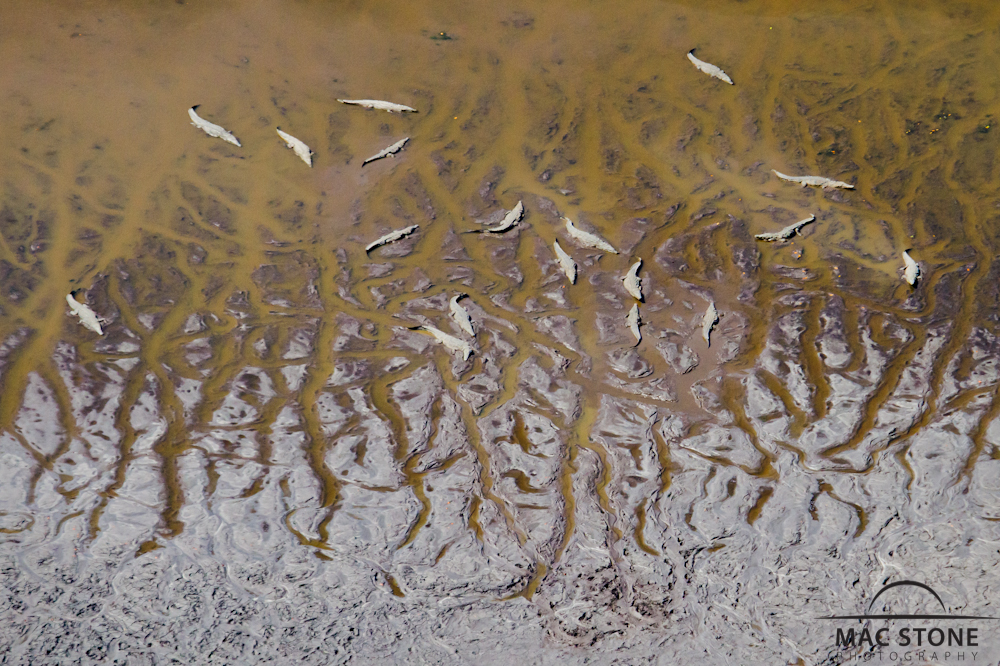
Taking to the air, I scouted out locations where I thought they might congregate. It turns out flying over Cape Sable during a cold winter day the best way to see American crocodiles in the Everglades. While this made for a couple “keeper” images, I needed something better, closer, where viewers could get right down in the dragon’s lair.
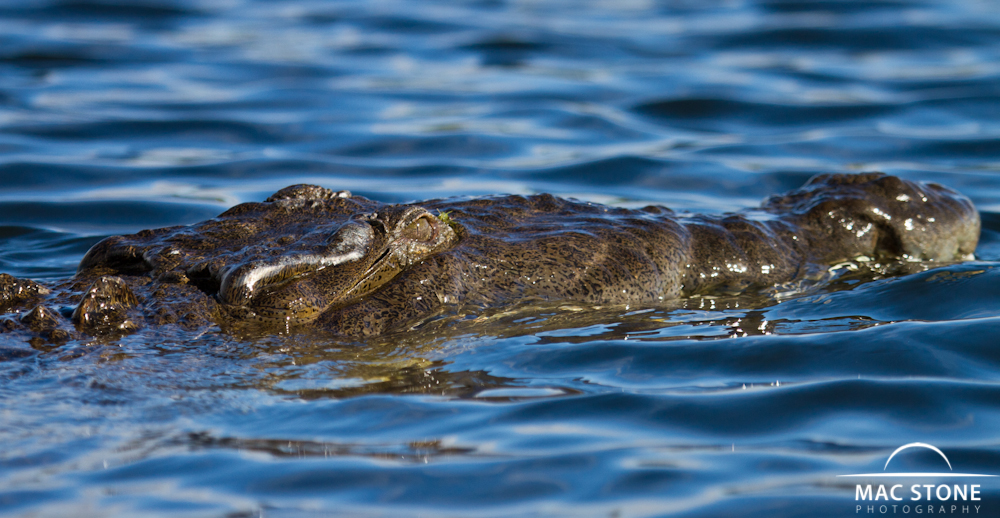
Luckily I’m not the only one down here who thinks these sorts of missions are fun. A few friends of mine, Garl Harrold, Mark Parry, and April Geisler were all patiently waiting for a cold weekend to sweep through the Everglades this winter to get close looks at crocodiles. We had one day where the temperature was just barely cold enough and water levels moderately low to concentrate the reptiles in a few remote locations. I had my bottleneck!
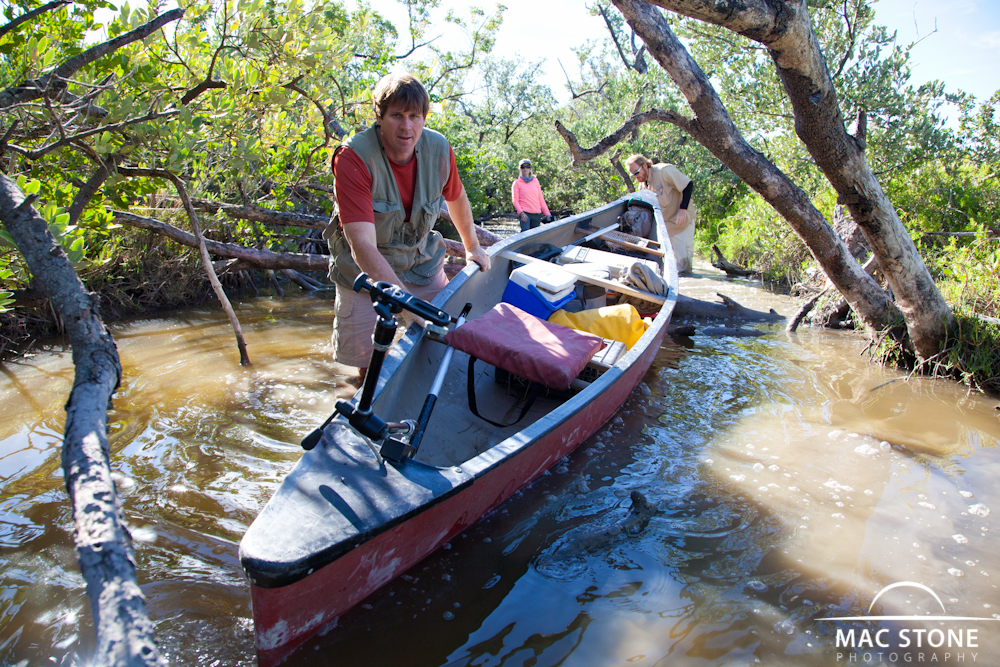
We woke up at 4 AM and trailered a boat loaded with a kayak and canoe out to the park. Putting in right at sunrise we headed out for the Cape Sable area. Anchoring the boat, we portaged the kayak and canoe loaded with enough food, water, and camera gear through salt marsh until reaching the water. While I cannot disclose where this area is, I will say that it’s no easy task to get there.
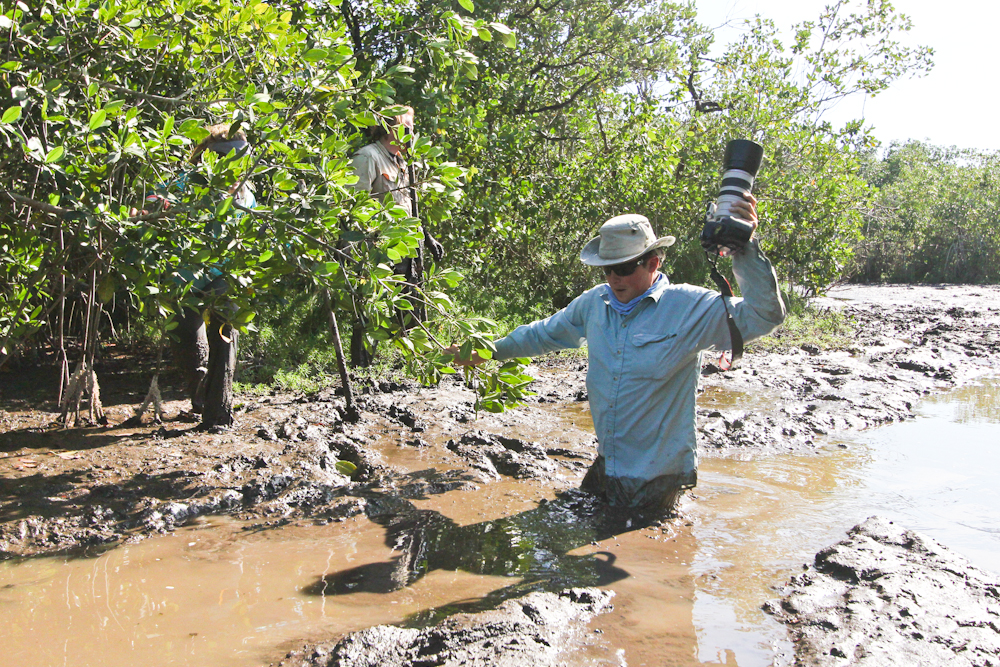
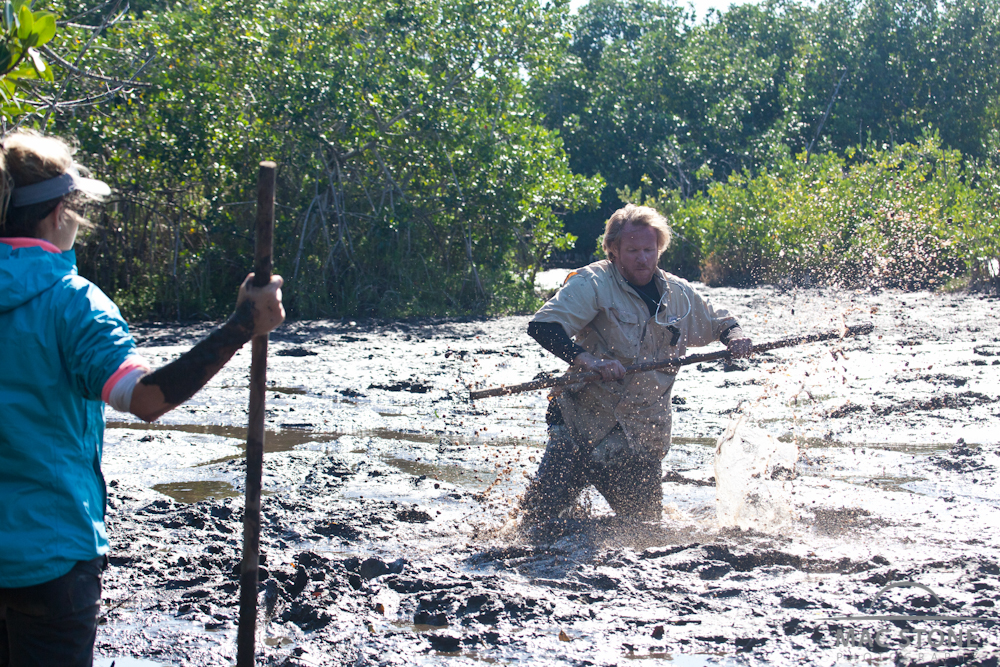 Paddling 7 miles, we finally made it to the mud banks where the year prior I saw over 40 crocodiles, only to find they had all slipped into the water. It turns out the 60-degree weather just wasn’t cold enough to keep them from moving. I was almost heart-broken. Muddy, wet, sore, and tired, I knew I’d have to wait another year for a shot like this.

Disappointed, we anchored the boats and started eating lunch until Mark yelled out from the shore that he found a croc still submerged in the mud. We slogged over and it took me about a minute to actually see the crocodile. Its whole body was camouflaged with the mud and the only part visible was a neon green and yellow eye glowing in the afternoon sun. This is what I came for!
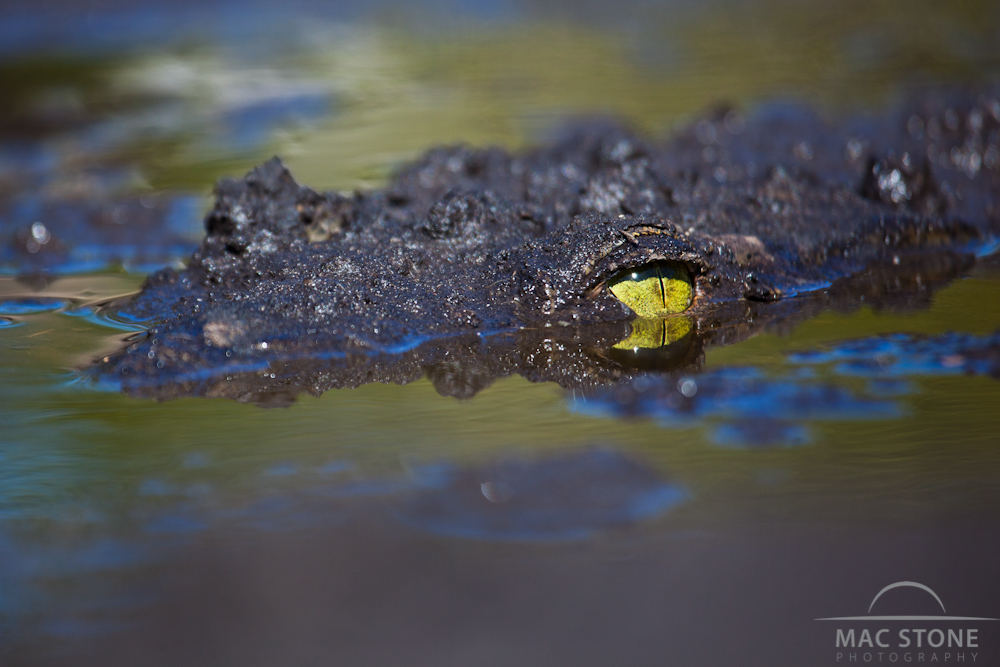
Slowly and cautiously, I walked around the crocodile so as not to scare it off or scare it towards me, and began shooting photos from a distance. Once I felt the 8-foot croc was comfortable or tolerant of us being there, I moved in a little closer. The tingling in my fingertips and tension in my thighs felt the palpable presence of wild nature. Those of you who have been close to large wildlife, know exactly what I’m talking about. I want to believe I made a connection with this crocodile, that we bonded for a moment, but the biologist in me knows that it’s a simple calculation in the crocodile’s mind which allowed me to stay. It was cold and he didn’t want to spend the energy to defend his spot. Ten very sweaty and nervous minutes later, I had the image I’d been envisioning for the last two years.
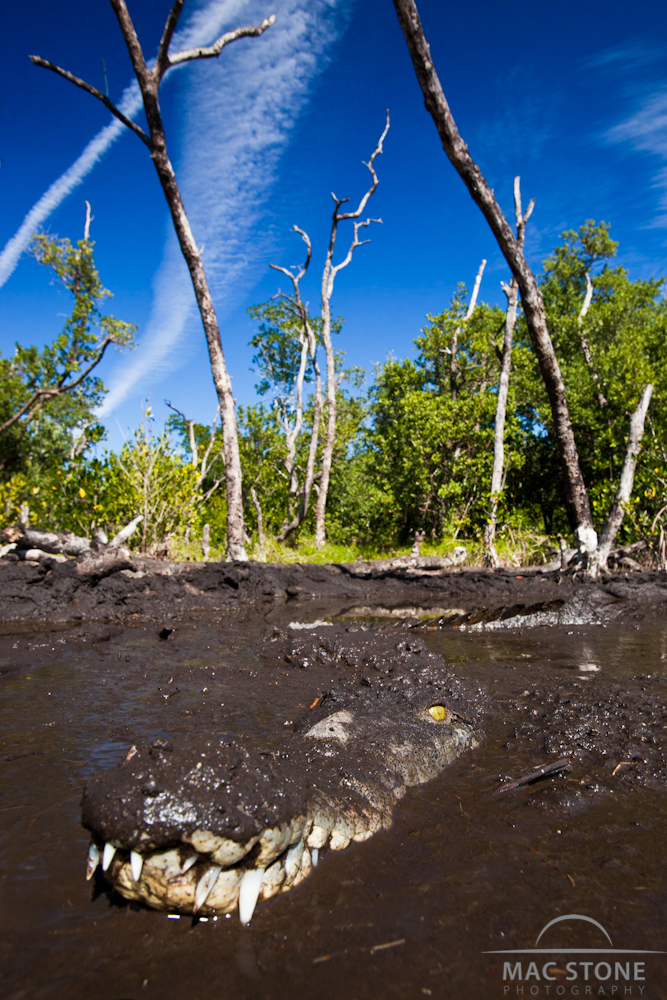
The difference between how I felt just before biting into my lunch, knowing that we hadn’t found the crocodiles we came to see and finding ol green-eye laying up in the mud was a complete 180. I know I shouldn’t rely on wildlife for the barometer of my happiness, but after years of planning I was too emotionally involved. Treasure hunters probably feel this way all the time. Luckily this year we didn’t come up empty-handed, or one-handed for that matter.
All jokes aside, wild crocodilians are not what I would consider to be aggressive animals. When unprovoked and unmolested they are simply observers and tend to avoid humans at all costs. To them, we’re big potential predators and they want nothing to do with us. To assume that every alligator or crocodile is just waiting for a chance to bite people is baseless. To this day there still has yet to be an unprovoked alligator or crocodile attack in Everglades National Park and there is no shortage of tasty tender-skin tourists running around. Still, I do not encourage people to get close to alligators, crocodiles, or other animals. I was accompanied by a wildlife biologist who works professionally with crocodiles and alligators and I myself have years of experience with these animals. No crocodiles were harmed in any way in the making of these photos. Please do not attempt this in your local swamps or parks.
Savage Race Orlando


Arthur Marshall Foundation: It’s My Everglades
Two months ago I was invited to join a canoe expedition sponsored by the Arthur R. Marshall Foundation. It was my job to document their third consecutive year of traveling the historic River of Grass. The leg of the trip that I joined was from Sawgrass Recreation Park down to the Tamiami Trail, about 76 miles.

Two years ago the expedition started at the Arthur R. Marshall Loxahatchee Wildlife Refuge and planned to follow the water all the way down to Florida Bay, in order to raise awareness of South Florida’s need for clean, free-flowing water. Today the expedition has become a massive effort to involve the public, especially children, with Everglades restoration. Embracing the new technologies, we would set up live from-the-field video classrooms using iPads with elementary schools all over south Florida and describe to the students what we saw and experienced while on the water.

 I love multi-day expeditions and I jumped at the offer. I made sure to pack as light as possible, even though my camera gear alone weighed 60 pounds. In order to compensate I left all articles of what I deemed “unnecessary” at home only to learn that I would be the only one without a pillow, sleeping pad, or camp chair. Bummer. Fortunately though, I had no problem sleeping after the gourmet meals, provided by the phenomenal cook Gisa Wagner. I’m pretty confident this was the only time I’ve had lamb stew and fresh broccolini marinara pasta, of course with grated parmesan cheese. This is my style of camping!

walked around the campsite with headlamps ablaze.
On the last day of our trip we pulled into the Tamiami Trail boat ramp. Only a few hours later, the Florida Wildlife Corridor Expedition team, Carlton Ward Jr, Joe Gutherie, and Elam Stolzfus rolled in exhausted from the last grueling 5 days of their journey from Florida Bay. When I saw their faces, I felt horribly guilty of those delicious calories I had marinating in my stomach. Well, sort of.

I hope you enjoyed the video. I must say thank you to the Arthur Marshall Foundation and the talented and brilliant paddlers I met while on the trip. I can’t wait until next year. Also a special thank you to Susan Sylvester, who is entirely to credit for any footage I got while on the water. I promise I’ll try to rig up a system where I can shoot and paddle at the same time for our next trip!
Roseate Spoonbills


We’re finding a healthy variation of chicks at different stages, from hatchlings to fledglings, all across the Bay. This isn’t out of the ordinary but it helps us see how these birds’ nesting schedules are related to food availability. For example, in the northwestern section of the Bay where tides control water levels, spoonbills nested earlier in the season because they could find sufficient food as tides withdrew. When you boat eastward where wind and rainfall controls water levels, you find that spoonbills choose to nest later, waiting for the dry season to kick in. Once water levels are low enough to amass fish in large concentrations, adults will commit to laying a clutch. With shallow water bringing an abundant food source, adults will be able to sustain their young through the nesting season. That’s the plan, at least.

Recently a cold front pushed through south Florida and dumped rain for three straight days. What seems like a small event to us, a 4-inch rise in water levels effectively disables the spoonbills from accessing optimal foraging grounds. Immediately after, across the board, we witnessed an abandonment of nests and several chicks not far from fledging, washed up in the mangroves. While it’s too early in the data set to directly connect the rain event to nest abandonment, we can’t say it was entirely coincidence.

I can’t tell you how heart-wrenching this is to see, how helpless they look, but it’s the reality that these birds live with. Albeit disturbing, this is exactly the point Audubon is trying to drive home. Water levels determine everything in the southern Everglades and Florida Bay. While we can’t control the weather, we are controlling the water flowing from the north and we must be extremely careful with how we use it
Gettin High

I’m constantly trying to find new ways of seeing the Bay. I’ve been fortunate enough lately to find friends around South Florida and organizations willing to take me up in their fixed-wing planes. Of course I always fail to mention to the pilot, until I’m strapped in that I don’t do well in small aircrafts. Once they start looking for any spare bags I then offer them the challenge of trying to get me back on the runway without incident, as if it were any measure of their skill.


Of Feet and Fine-Art


Murder of Crows

As if the Everglades didn’t have it tough enough with restricted water flows and enormous invasive pythons, an additional assailant has found refuge in the park. The American crow, whose call can be heard from Cape Sable to Flamingo arrived with the influx of visitors who leave their food unattended and car doors open. Unsatisfied with the scraps of tourists, they have moved on to finer dining. On the islands close to mainland, spoonbills and reddish egret nests are pillaged by roving gangs of crows leaving only hollowed eggs and bloody carcasses. Suspected to attack only when the parents are off the nest, Audubon has coordinated with Everglades National Park to close several channels that pass through sensitive nesting areas for this very reason. I was surprised then, when I witnessed two crows attacking an osprey nest as the mother stood guard over her clutch. They pecked, squawked, and surrounded her for 20 minutes until giving up, probably to return the following day for another fight. If they are this bold with a sharp-beaked and razor-taloned osprey, how would they fair against an unassuming pink spoonbill?

I’ve already found at least 6 nests ravaged by crows, and if the problem persists, it could just be enough to force a colony to abandon their young. Not too long ago a burmese python was spotted swimming in Florida Bay, probably on its way to one of the mangrove islands. Imagine if a 10-foot python descended on a wading bird rookery. At this rate, maybe it’s only a matter of time. Do we really need to love all creatures equally?
Send Off: Florida Wildlife Corridor Expedition

 This morning Jerry Lorenz and I drove out to Flamingo in Everglades National Park to send off a friend and fellow conservation photographer Carlton Ward Jr. who embarked on a 1,000 mile expedition. This adventure is known as the Florida Wildlife Corridor and will help to lay the foundation of a conservation initiative linking critical fragmented landscapes. It’s an extremely bold task and I’m so upset I can’t go with him. Joining Carlton, is filmmaker Elam Stoltzfus, and bear biologist Joe Gutherie, two brave souls who say they’re “in it to win it.” Carlton’s expedition will meet up with artists and paddlers all over Florida as they make their way north. I’m planning on meeting them on the 24th while accompanying the Arthur Marshall Foundation who are on their own paddling expedition to show the importance of our waterways in south Florida. First, though he’ll have a hearty paddle up to Avocado Creek and then a rough slog atop jagged limestone through miles of sawgrass in Shark Slough. When I said goodbye to Carlton and his crew today, he said, “I’ll see see you in a few days!” With a nervous tone I replied, “Yeah, I hope so…”

Winter, By Any Other Name…


Lost and Found

I love watching adventure shows where the protagonist drops in on an island and must use his immediate resources to survive or escape. I’m always skeptical too, of the serendipity that Bear Grylls just happens to find a 30 foot rope, a lighter, or gallon jugs half-filled with potable water washed up on the shores. Surely, the producers must have planted some of that stuff before filming. I held this skepticism until I started exploring the islands in Florida Bay for our spoonbill research with Audubon. Now, I find myself eager to go to work if not just for the spoonbills but also because I never know what I’ll find while walking through mangrove tangles or kayaking along the mud flats.

The most common things I find are colorful stone crab buoys which at a distance have fooled me to believing there were flamingos in the central bay. I have also started a collection of drink cozies with faded tackle shop labels. Antique bottles are a great treasure to find and I have a couple that date back a century. There’s no shortage of homeless sandals either. Crocs brand are the most common, and if anyone needs a size 9, 10, or 12, then I have you covered. Why is it always the left shoe that people lose?

It’s no surprise really. With all the boaters, residents, and visitors to the Keys and Everglades a few things are bound to arrive on the islands of this 850 square-mile wilderness. For years the Everglades was renowned for its lawless backcountry allowing drug smugglers a perfect location for trafficking. Veteran fishing guides who wish to remain nameless, muse on the days of their biggest catches, landing large “square groupers,” caught in the tidal flats which would fetch $200,000 at market price.

While contraband busts rarely run the headlines, the Everglades remains vast and largely unpatrolled by park officials. Just last week, while exploring an island in the northwest Bay, I saw something strange washed up on a sandy beach.

A blue vessel, made of canvas stretched over two large tire inner tubes with oar-locks, and a heavy plastic keel, sat abandoned at the high tide line. At closer inspection, inside the cockpits were cans of tuna, varying flavors of soda, and a couple of sweaters. Although the labels slightly worn, I could tell immediately where this raft came from. It’s incredible to think two people floated in open ocean aboard this backyard-assembled dinghy. Being only 90 miles from Cuba, Florida Bay is really the perfect destination for refugees. I just hope they didn’t get too antsy and try to swim the remaining 5 miles to mainland through the shark and croc-infested water. For a moment, I looked up, scared to find the stranded sailors watching me from the trees, but at this point they were long gone.

I may not be Bear Grylls, but I’d like to think that if I were to be stranded on one of these islands, I’d be able to survive just fine. With my luck, I’d just hop on the next abandoned life raft and paddle safely to shore, gorging on canned tuna and orange soda.
Christmas Bird Count!

Every year National Audubon conducts bird counts in each state to assess the health and status of bird populations around the country. From December 14th through January 5th of 2012, thousands of volunteers selflessly dedicate their time to slog, hike, boat, and paddle with guide books, binoculars, and checklists in hand. For many, this has become a family tradition as it’s a great excuse to get outside and see some incredible wildlife while contributing to conservation.

 To be honest, I was a little nervous about my first count. I know my wading birds and raptors fairly well but identifying shorebirds and songbirds is so frustratingly difficult for me that I feel I’m a disgrace to the Audubon name. My redemption would be found in calling out the bright pink roseate spoonbills flying against the stark blue sky. Fortunately, I was assigned to be captain of a boat with two of the most knowledgable birders and naturalists I’ve ever met. Rafael Galvez and Michelle Davis just finished a bird count on the Dry Tortugas two days prior and politely assured me all I would have to do is steer the boat. Huge sigh of relief.

The Tavernier Science Center hosted the bird count of Florida Bay and the Upper Keys. With a team of 15 birders, biologists, enthusiasts, and naturalists we scoured the region from 6:30 AM until 6:00 PM. We identified 95 species and counted 11,164 individuals!

 Part of the purpose of the bird count is to also help determine the range and migratory behaviors of certain birds. Our team spent a great deal of time just trying to verify the identity and number of semipalmated sandpipers. Florida Bay, it turns out, is the only place where these birds don’t continue to fly south for the winter. Florida Bay is also the only place to find prairie warblers with a distinctive orange coloration in their faces.

The hardest groups to count, however, were the floating mats of cormorants. Any guesses as to how many are in the photo above?

After participating in my first bird count, I can see how it attracts so many volunteers. My group alone accounted for 5,640 birds, which is an incredible sight to behold in an 11 hour period. I would highly recommend the Christmas Bird Count to anyone looking to spend a day outside for a cause certainly worth supporting. I’m definitely going to make it an annual tradition, wherever I might be.
Roseate Spoonbills

Starting in November, I accepted a small promotion within Audubon’s Tavernier Science Center office as head of spoonbill research. For the last two years I have been working with prey-base fish monitoring, so this will be a much welcomed change. The spoonbill position requires that I go into the field every week to collect data on spoonbill populations and their nesting success for the entire Florida Bay. Doing so means that I must visit nearly every island in search of spoonbills and report back to state director of research, Jerry Lorenz. So far it’s been slow as water levels are still fairly high, but we’re not quite sure what to expect this year. Already we’re seeing some shifts in their range, but only recently did I find my first nest.

Trends have shown an overall decline in spoonbill nesting success in Florida Bay. In the northeast Bay, colonies once hosted up to 600 nesting pairs, now we’re struggling to find a handful. These declines started right after the construction of the C-111 canal that drained much of the Taylor Slough watershed out to the Atlantic. Our research is helping to provide water management authorities with the empirical data they require to shape policies and change the flow of water. It is our belief that bringing more freshwater back into the system will provide more productive foraging grounds for spoonbills and other wading birds.

Only time will tell us if we’re on the right track as Everglades restoration plans are underway. In the mean time, I’ll enjoy trudging through mangrove islands and boating across the Bay in search of these pink beauties.
Where the Wild Things Are

 That’s what Hannah said as she walked, crunching the brittle ground with every step under a palm tree canopy lining the shore of Myakka River. It was perfect the way it hit her, like recognizing an old friend. She couldn’t stop smiling, gazing around at the strange landscape. And I felt the same way too when I first visited Myakka River State Park ten years ago. There’s something incredibly wild, fabled, and yet, familiar about this place, like we’ve been told about it before.


Florida’s Special Places: Corkscrew Swamp
About four months ago I started a proposal with the help of National Geographic producer Katie Carpenter and director of Audubon Florida Eric Draper to create short HD videos highlighting Audubon’s role in protecting Florida’s special places. The idea came at the heels of my Florida Bay videos as I began to realize that a great deal of the public has very little clue of what this organization does around the state. We thought that combining interviews with compelling imagery and videography would be a great way to connect to the masses.

October was my first shoot, as it was a time-sensitive issue. Around the second week of that month every year wild sunflowers bloom and surround Corkscrew Swamp Sanctuary. It’s a spectacular sight to see and if we were going to include it in the video we wanted to capture it at its peak.

Thankfully, Jason Lauritsen the assistant director of Corkscrew was willing to wake up before dawn and pick us up in one of their swamp buggies. This put us up above the sunflowers and offered a really unique perspective that I otherwise wouldn’t have been able to get.


I spent the next two days slaving away from dawn until dusk capturing as many close-up and wide angle shots as I could before wrapping it up. The devil is in the details and I’m still learning to think like a videographer. Because we have a set budget I had to treat the assignment like I would never be coming back, so the added pressure helped to keep me shooting all day. A lot goes into these small productions and while digital SLRs are great in that now include high definition video capabilities, there’s no limit on the amount of accessories you need to make it fluid. I’m usually a very light traveler (in comparison to some other photographers) because I like staying mobile. No such luck on this trip. My packing list included:

Canon 5d mark ii camera body
Canon 24-105mm lens
Canon 16-35mm lens
Canon 100-400mm lens
Canon 100mm macro lens
Redrock Micro shoulder mount
Manfrotto tripod with fluid head
Manfrotto tripod with ball head
Two Canon external strobes
Rode Videomic Pro
Sennheiser wireless mics
Diffuser
4 Batteries
100gb of flash memory cards
500gb external hard drive
MacBook laptop
And there’s still more I’ve acquired since then! Luckily I drove my truck. Although, the truck didn’t help much when I had to schlep most of this gear down the boardwalk all day. I hope you enjoy the video. Feel free to share it with friends. It was edited by Josh Cook in New York and will be the first in several more to come.

At a Loss

Water management in south Florida has been at the forefront of environmental and political debate ever since the turn of the twentieth century. Surprisingly, even today with all that we know of the Everglades and its significance to Florida and imperiled watersheds all around the world, we’re still struggling to get it right.
The taxes to be cut are taxes on homeowners. If you have a home valued at $100,000 then you are saving $15 a year from this monumental tax break. I know what you’re thinking, “holy crap, what am I going to do with all this extra cash now?!” The possibilities are endless. At the cost of science and hundreds of jobs, we can all enjoy a few more lattes from Starbucks or that leopard-print Snuggie we’ve always wanted.


He and I flew out early in the morning over the ridge and sloughs of the southern Everglades. Restricted water flows had started to show their subtle but detrimental affect on the landscape, now clearly visible at 800 feet. He looked on, despondent and removed, like an artist stepping back from the canvas to see strokes and details incongruous with his original vision.

 When we landed at Rocky Creek and hauled away the first load of boardwalks, Jerry had trouble finding the words to express his disappointment. It took days to build the site, months to scout it out, and years to figure out its place in the greater watershed. After a matter of hours, it was completely gone. The helicopter carried out the last load and we sat silent, tired, and wet under the dissipating hum of the propeller. Jerry looked on as it faded into the horizon, but stayed watching, perhaps hoping that it would turn back around.
A deep sigh from a frail resolve was the only audible sound I heard as we crouched in the water, quietly waiting to be picked up. Disappointing is hardly the word. Heartbreaking is more appropriate. I could see it in his face and weighing on his shoulders. Jerry and a number of other biologists have invested their lives protecting the Everglades through science and reason. Ever since restoration became a statewide conversation they have been Florida’s most trusted voices. Now their throats are hoarse from screaming into deaf and often indifferent ears.
A Day with a Legend: Nathaniel Reed

You would be hard-pressed to find anyone more influential and active in Everglades restoration as Nathaniel Reed. He is a giant, both physically and legislatively for the conservation of Florida and even the world. He’s known for serving under six governers, two presidents, and is partly responsible for such legislation as the Clean Air, Clean Water, and Endangered Species Acts. Yeah, big time.

 Last week, it was one of my greatest privileges to share a boat with Nathaniel on assignment for Audubon Magazine. Guided by Paul Gray (left), another dominating figure in Everglades restoration, and FWC biologist Don Fox (right), we explored the marsh habitats of Lake Okeechobee.

These seasonally flooded grasslands are one of the main habitats for apple snails which are the sole diet for the snail kite, an endangered species. Recently, kite populations have been increasing and the bird community is buzzing. I felt so lucky to share the moment when Nathaniel watched a kite fly in and devour a snail right in front of the boat.
Ironically, I was shooting video for the magazine to run as a companion piece to their recent feature story on Everglades water issues written by Ted Williams. So I will let you know when that’s ready to view online. Until then, I just wanted to share my excitement of spending an afternoon with one of Florida’s true heroes.
Savage Race Debut

Some of you may remember the entry a few months back about the promotional shoot I did for Savage Race and Map Cap Events. Using those photos of my friends from the mud pits of Homestead, Florida the Savage Race crew was able to promote their event in all different types of media and in less than four months attract over 2,000 people for their debut on August 27th. The day before the race I had a chance to walk the course and help put some finishing touches on the obstacles and mud pits. Sam Abbitt and Lloyd Parker (owners and managers of Savage Race) made sure the 5k was going to be brutal and live up to its slogan: “the race built to kick your ass.” In fact, the property was an old sand mine and current ATV course on the outskirts of the Green Swamp, which I had just visited for Florida Forever a few months back. While setting up I saw a few cottonmouths slither across the trail and had to laugh. The 2,000 plus people carb-loading on Friday night had no idea what they had in store.
On the morning of race, it was funny to see the images of my muddy friends from Homestead plastered all over banners, t-shirts, and even water bottles. The crowds slowly trickled in as the first wave commenced at 9:00 AM. There were already 6 photographers covering the race but they focused only on images where bib numbers and participants’ faces were clearly showing. My assignment was to take images for promotional materials which requires a completely different style of photography. Luckily I had a four-wheeler and driver at my disposal so I was able to stay mobile throughout the day.
The trickiest part was just making sure my lens stayed clean with all the mud that was slung around. I took nearly 1,900 photos that day but here are a few favorites..


You know that I couldn’t just sit there and watch everyone else have all the fun, so I jumped in the last wave at 12:00 and put my grit to the test. I had a slight advantage knowing all the pitfalls and obstacles of the course, but even then it was a brutal 3 miles. Halfway through my wave a massive lightning and rain storm swept through central Florida and I could barely see more than three feet in front of me. I finished in 39 minutes but wasn’t able to attempt the swim because of the lightning. Unfortunately the rain also forced everyone home including the band, the vendors, and all the participants waiting to celebrate their mud run. I felt bad that the Savage Race crew didn’t get a chance to see their event completely unfold, but during hurricane season these things are a little hard to predict. And besides, what’s more savage than a lightning obstacle?
The next race is scheduled at the same location for sometime in February 2012. Check out their website SavageRace.com and sign up. It definitely rocked me, but I’m ready for another serving. Please sir, may I have another?!
 Mac Stone Photography