![]() |
| “Edge of the World” – Florida Bay – Everglades National Park |
Latest
Get Low
NANPA High School Scholarship Program
In February of next year, 10 more lucky students will have the chance to attend NANPA’s fourteenth high school scholarship program for a chance to learn from the industry’s top shooters and photography publishers. I’m extremely excited to announce that I will be taking over as chair of this program and will be joined by instructors Ray Pfortner, David Moynahan, and Marina Scarr in Jacksonville, Florida. Only ten years ago, I was one of the fortunate few selected for this program in Albuquerque New Mexico and I can’t begin to count the ways it has shaped my life. Now, here I am about to take lead on cultivating the next generation of nature photographers in my home state!
We are seeking talent from all over, so if you know of any high schoolers or students 14-18 years old with a passion for photography please send them this invitation. You never know how it might shape their lives.
Pretty in Pink
The spoonbill saga continues. I just went down to the Keys for a week to train the new head of spoonbill research at the Tavernier Science Center. When I walked in the office, Dr. Jerry Lorenz handed me a book from Bearport Publishing. I completely forgot I submitted images nearly 6 months ago on this project and here it was, printed, bound, and ready for distribution.
The author, Stephen Person, contacted me early this year to help collaborate on a children’s book about the roseate spoonbill and the work we did with National Audubon and the Tavernier Science Center. Jerry helped with the text and while it has the illustrative feel and design of a children’s book, it’s actually incredibly informative about the Everglades ecosystem and the lives of these beautiful birds. If you have a child who needs a good book this Christmas, give this one a shot. You can tell them you know one of the photographers!
You can find it here on Amazon: Roseate Spoonbill, Pretty in Pink
Caption Contest on Facebook
Love for the Swamp
![]() |
For those of you that missed it in the bookstores, BBC Wildlife Magazine did a 13-page feature portfolio on my work in America’s Swamps. This was pretty exciting for me as a photographer, but especially significant from a wetland conservationist standpoint. We’re finally getting swamps some positive PR!
The BBC staff are top notch. They’re extremely thorough, inquisitive, and insightful; so when I was going back and forth with them about the layout and captions, it was a surprisingly painless process. The only complaint that they expressed was not having enough pages for the images I submitted. Can’t get better feedback than that!
If you’d like to check out the actual portfolio complete with captions in PDF version: Click Here
Or, you can find the online gallery of some of these photos here: America’s Swamps
Congaree National Park
![]() |
| Water moccasin basking along Cedar Creek in Congaree National Park – © Mac Stone |
Three years ago during the spring season I worked as a canoe guide and naturalist in Audubon’s Francis Beidler Forest. You’ve heard me brag about this place countless times but that’s because it’s one of the more magnificent places I’ve ever been. I remember feeling like I was part of a team, not just because I worked with other dedicated people in the same building, but because we were constantly trying to find new recruits for Four Holes Swamp. We had to earn the adoration of each wary soul that walked through our door because we wanted to be the darling of the lowcountry, the gem of the sodden bottomlands. This might have been an easy feat if we were the only ones promoting large tracts of cypress and tupelo swamp, but there was another nature reserve only an hour away with a bigger budget and a wider audience also offering boardwalk tours, canoeing, and large old-growth trees: Congaree National Park. In my three months of living only 45 minutes away, I never took the time to visit the park; partly out of spite, partly out of a swelling pride, but mostly because Beidler had everything I needed. I didn’t realize it at the time, but I had been chugging the Beidler Kool-Aid for so long that when I left for the Everglades in the fall of 2009 and ran into a former Congaree National Park seasonal, we got into a heated debate as to who’s swamp was better. We had both been trained in the arts of tour-guiding and we knew our tag lines well. I would say, “We have the largest stand of old growth tupelo and cypress swamp in the world, enough said.” Heather would then retort with “Well, we have the largest tract of old-growth bottomland hardwood forest in the world.” And there we stood, proud, stubborn, and divided.
![]() |
| Old-growth cypress and tupelo trees along Cedar Creek in Congaree National Park – © Mac Stone |
![]() |
| Brown watersnake – © Mac Stone |
![]() |
| Colorful cottonmouth at the base of the tupelo tree – © Mac Stone |
![]() |
| Wise Lake, Congaree National Park – © Mac Stone |
![]() |
| Primitive hammock camping along Cedar Creek – © Mac Stone |
![]() |
| Self-portrait hammock camping – © Mac Stone |
Making the Dreamcatcher
![]() |
| “The Dreamcatcher” – Florida Bay – Everglades National Park – © Mac Stone |
![]() |
| “Anchored in the Bay” – Florida Bay – Everglades National Park – Photo © Mac Stone |
![]() |
| Me photographing “The Dreamcatcher” – Everglades National Park photo by Will Stone |
![]() |
| Photo by Will Stone |
This mangrove is massive and sits upon a large grass flat. To access at low tide, it requires a heart-pounding slog, which is particularly difficult at 6:00 AM. 99% of the time I use a tripod, but for the image “Anchored in the Bay” which I am shown photographing here, I decided not to bring it because I knew the light was strong and I wouldn’t be attempting any long exposures since the wind was steadily gusting. With any plant or tree-photography, wind is a huge factor. Typically I shoot in the mornings because the wind is calmer than in the afternoons. Since I’m looking for dramatic light I know that a windy day will cause the branches to sway and leaves to shake. In low light situations this is a deal-breaker for long exposures. Many mornings I left with the wind at 0-5mph only to arrive at the mangrove with 10-15mph winds increasing as the sun peaked the horizon.
![]() |
| Mangrove at dawn – Florida Bay – Everglades National Park – Photo © Mac Stone |
![]() |
| Photo © Mac Stone |
![]() |
| Photo © Mac Stone |
![]() |
| Photo © Mac Stone |
![]() |
| Photo © Mac Stone |
![]() |
| “The Dreamcatcher” – Florida Bay – Everglades National Park – © Mac Stone |
Finally, on what I determined to be my last chance of photographing this tree, I went out with a group of friends and a bucket of cold drinks. When I saw the clouds shifting on the western horizon, I was overjoyed knowing that perhaps finally I had my sky. I left the bucket and my friends on the boat and slogged out to the tree waiting for the sun to get just above the horizon. For thirty seconds it held and I managed two frames. I used a reflector to add fill light to the mangrove and a neutral density filter to smooth out the water. It was a culmination of all the right elements and I knew as soon as I triggered the shutter that this would be “the one.” It was a vantage point I never tried before, but I wouldn’t have arrived at the conclusion during the right light had I not tried a dozen times before from different angles.
![]() |
| “Dreamcatcher Dusk” – Florida Bay – Everglades National Park – Photo © Mac Stone |
![]() |
| Photo © Mac Stone |
The Dreamcatcher
![]() |
| “The Dreamcatcher” – Florida Bay – Everglades National Park – Photo © Mac Stone |
The Everglades hosts the largest continuous stand of mangroves in the world. These gothic trees, with their crawling prop roots and arching limbs, are one of my favorite subjects to photograph. They each take on their own personality formed by wind, water, light, and even by the birds that roost upon their branches. Of the entire 850 square miles of Florida Bay that I’ve explored, however, there is only one particular mangrove that I have come to regard as my favorite. It sounds ridiculous to admit this, to hold preference of one tree over millions, but this partisanship isn’t unique to just me. All of my coworkers at Audubon each have their adored mangrove, one that seems to smile back at them when their boats race by.
![]() |
| “Dreamcatcher Dusk” – Florida Bay – Everglades National Park – Photo © Mac Stone |
Florida Wildlife Corridor Expedition
![]() |
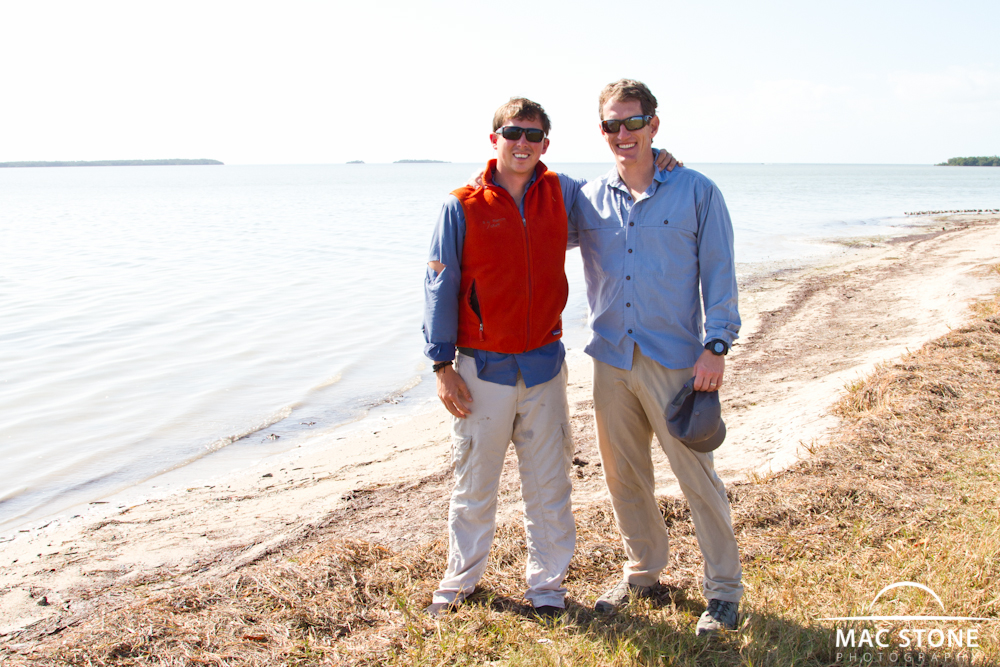
| Me with Carlton on the morning of their departure from Florida Bay |
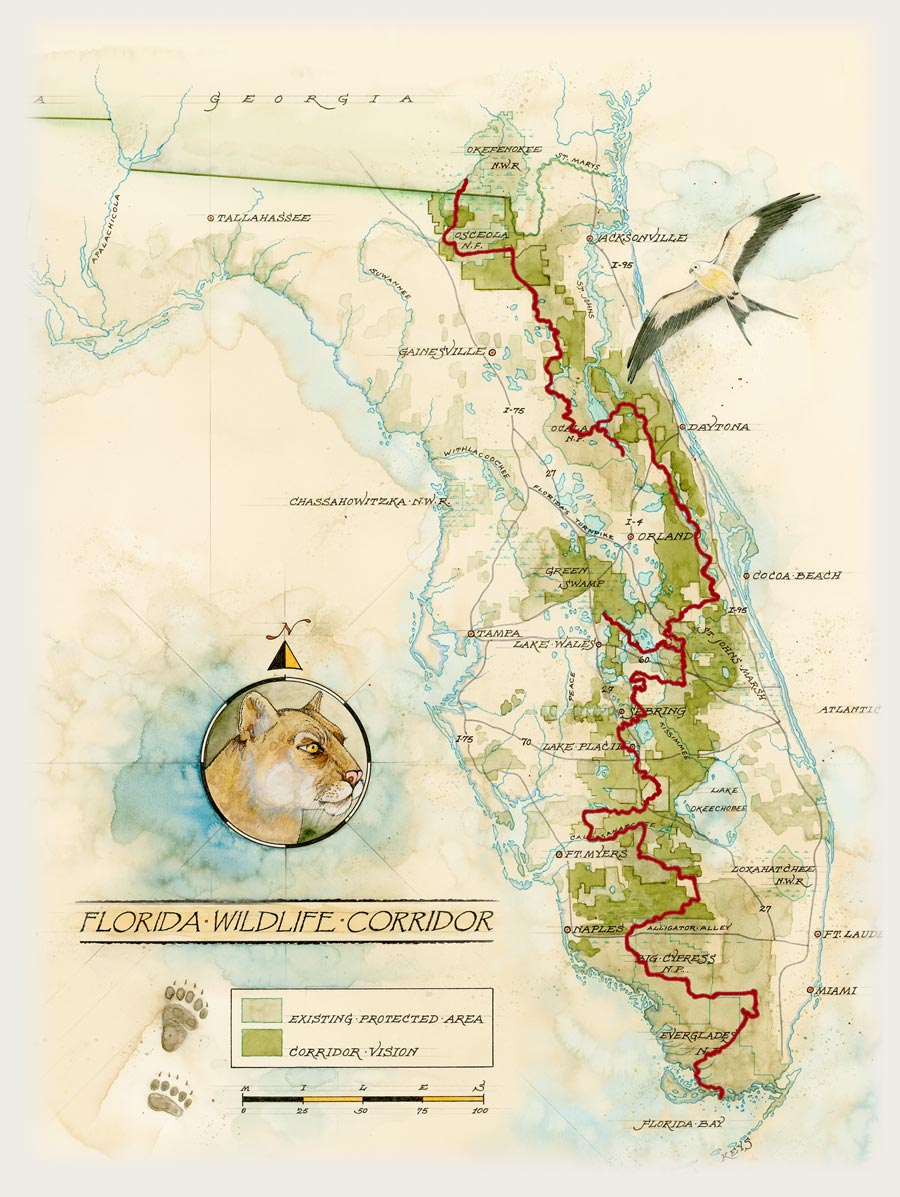
I was there for the first day of the expedition when Carlton Ward Jr, Mallory Lykes Dimmit, Joe Guthrie, and Elam Stoltzfus set out on their 100 day/1,000 mile journey from Florida Bay to Okeefenokee Swamp. I remember feeling a palpable envy knowing that they would be crossing some of the most wild and scenic regions of Florida. The simple idea of traveling 1,000 miles by your own sweat and grit, without the aid of pavement, is a crazy one by most standards. But crazy ideas and groundbreaking efforts are usually what it takes to move mountains. And if Florida is going to provide a corridor stretching from the Everglades to Georgia for endangered wildlife like panthers and black bears, well, some mountains will need to be moved.
![]() |
| Florida Wildlife Corridor Expedition map |
I planned on meeting up with Carlton and the crew along several stops of their journey but never found the time as I was wrapped up in my own adventures. When Carlton called me to come and join them on the final stretch through Okeefenokee Swamp, no matter what it was going to take, I knew I had to go. Having photographed his group for 100 days, it turned out no one had really taken images of Carlton, so it was my job to capture the essence of the group as a whole as well as its fearless leader. I felt a little like Nick Nichols on expedition with Mike Fay in the African Congo Megatransect, a story that I drooled over when it was published in National Geographic in 2001.
![]() |
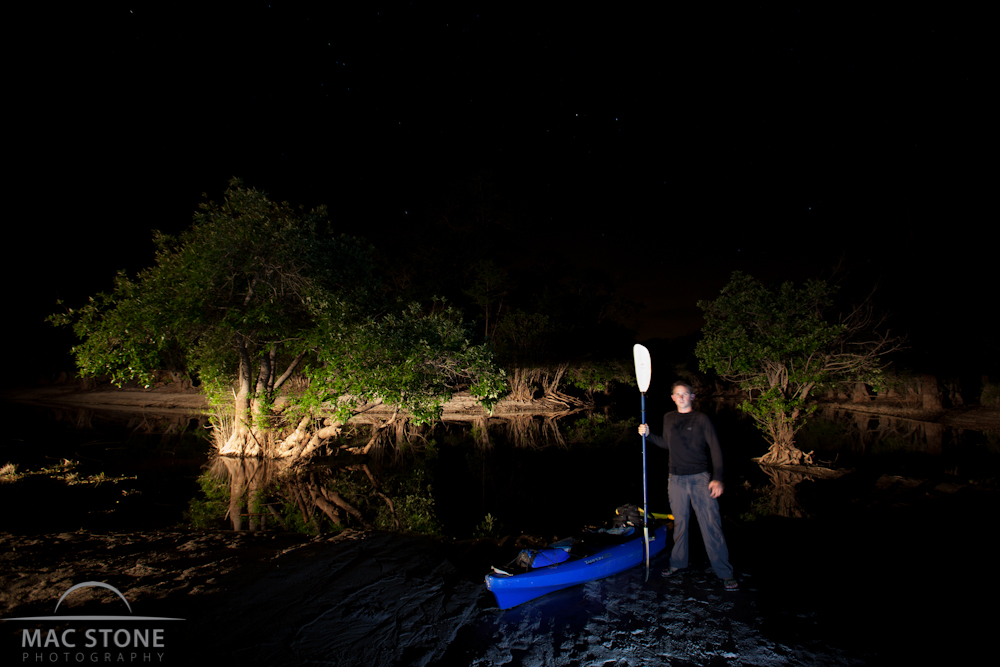
| The headlights of my truck offer a quick photo opportunity before taking off on the Suwannee River |
When I pulled into Griffis Fish Camp, it was 11:30 PM. There was no moon, just stars and a cacophony of frogs and toads. I had no idea where the expedition team was, just a general sense that they’d be South on the Suwanee River somewhere, camped along the banks. Carlton said he would leave a fire burning but that was at 9:00. I considered camping at the fish camp but knew that I needed early light photos of the group so I bit the bullet and paddled out into the darkness. My headlamp ruined my night vision so I turned it off and hoped for the best. Of all the things that could have scared me, the worst thing on the water at night were the wood ducks. It seemed they waited until they were right next to my boat when they would explode off the water. I felt so foolish when my nerves calmed. Finally, I pulled my kayak into camp around 1:30 and set up a tent, without so much of a stir from the team.
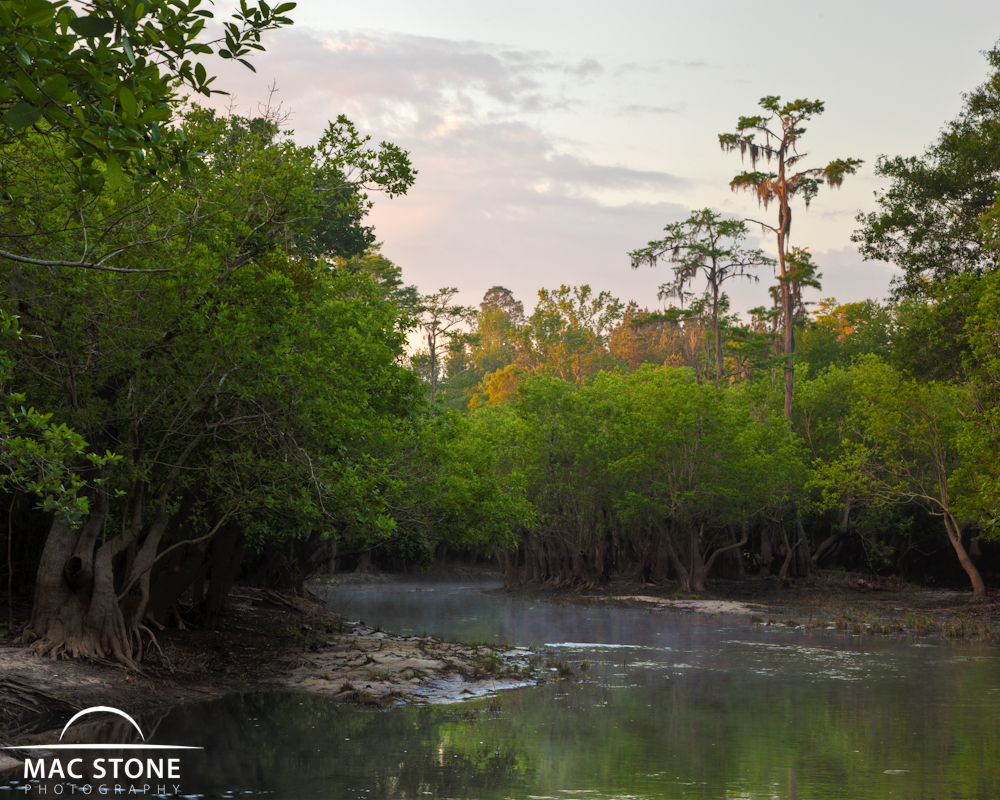
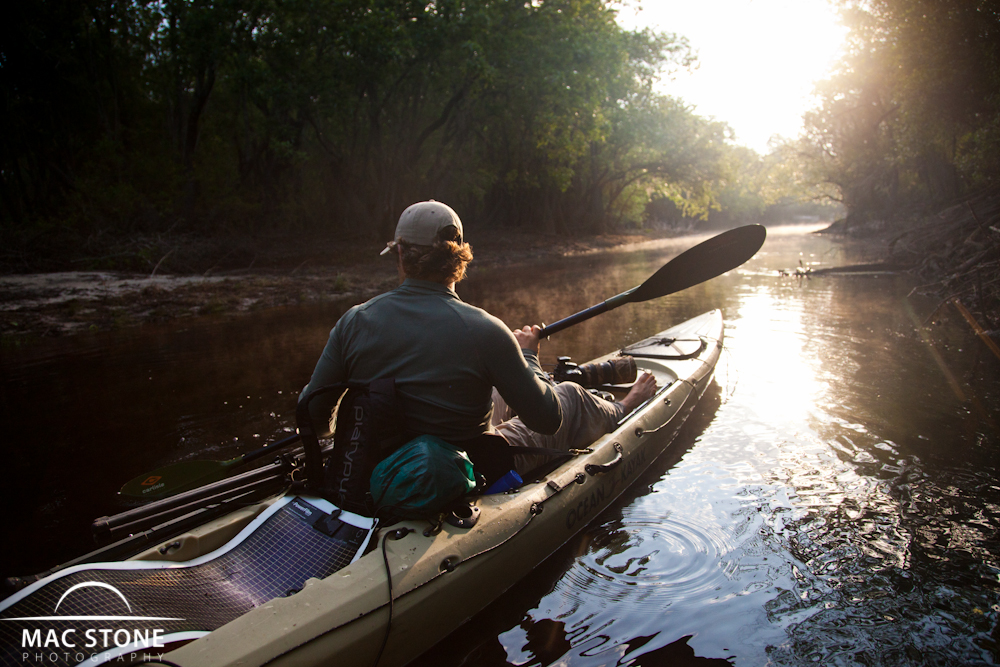
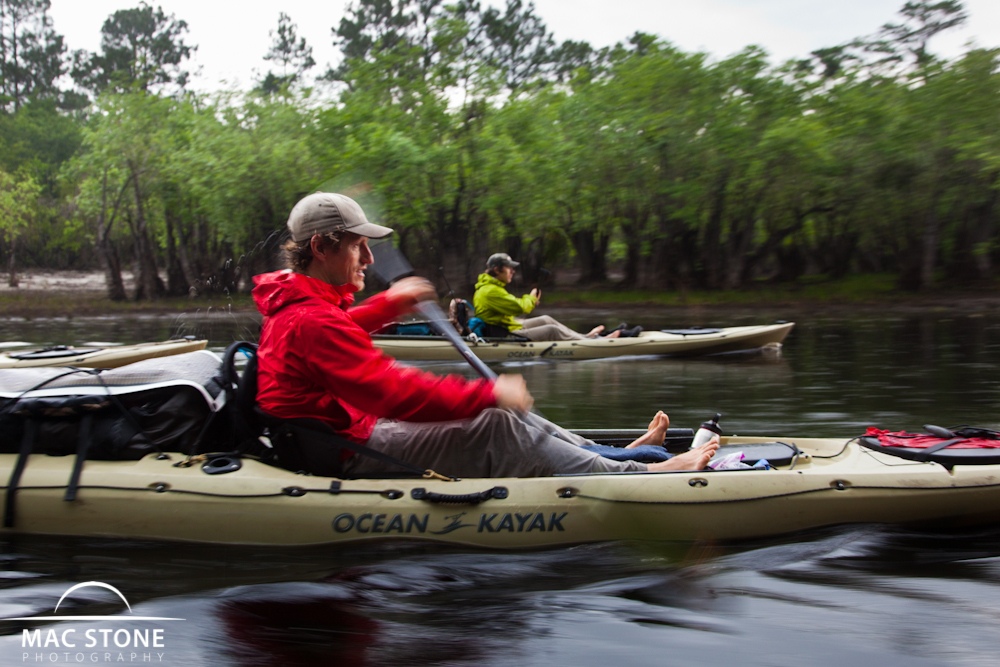
I woke the next morning at 5:30 to ready my camera gear and head out on the river for first light with Carlton. Polar fog was settling on the water and made for some great images with the looming tupelo and cypress along the banks. Carlton and I paddled upstream while the rest of the crew prepared breakfast and packed their tents. Photo shoots like these are tough. Since I didn’t have any time the day before to scout locations I had to work quickly to find compositions and opportunities where the light allowed. Luckily I was able to make a few frames before the fog lifted while gentle amber light still dappled the tops of the trees.
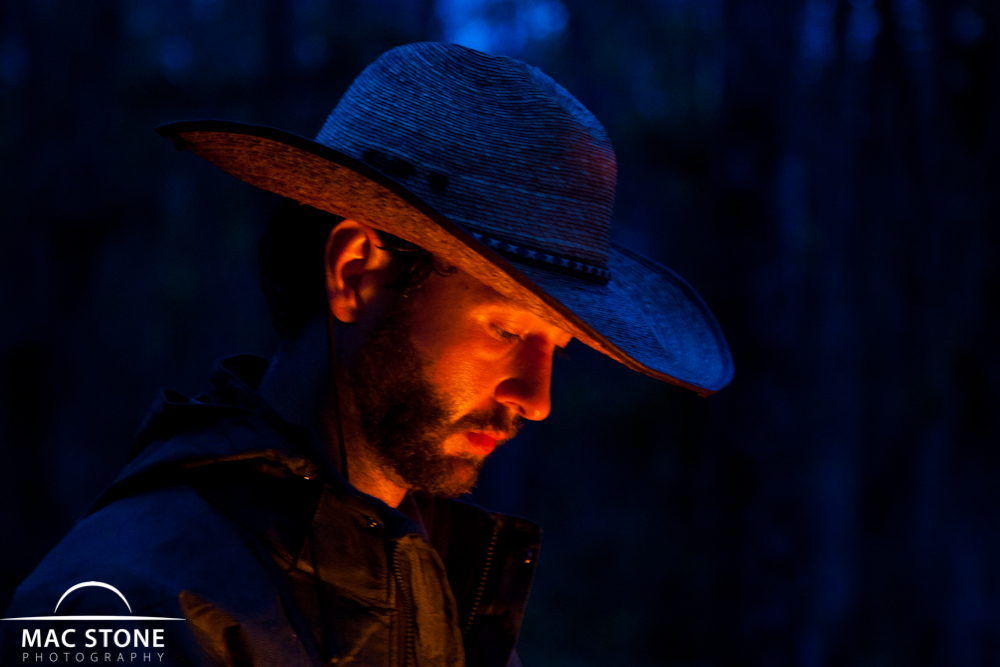
It’s an awkward thing being the subject of a photo, especially if you’re a photographer. All my friends will tell you the same thing as I constantly ask them to hold poses or look wantonly away from the lens. I think my girlfriend fears going out on hiking trips with me specifically for this reason. Carlton mused that he had never been in front of a camera so much as that morning with me. What can I say though? It was my job! I wasn’t going to let embarrassment or a small thing like courtesy get in the way of my images, I mean, do you think Nick Nichols would ever bashfully put away his camera with light like this? I don’t think so.
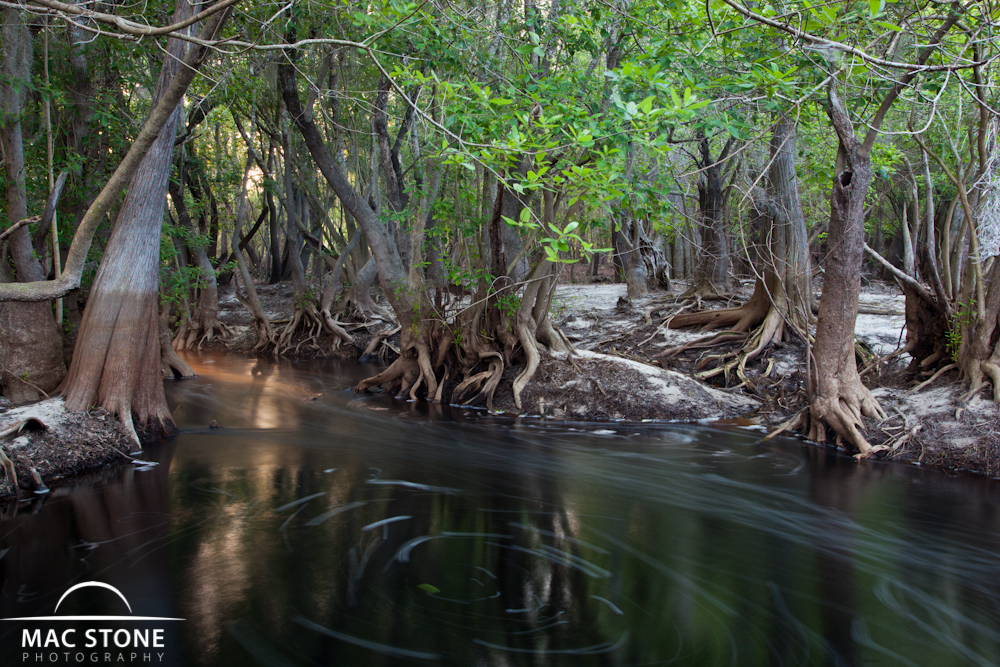
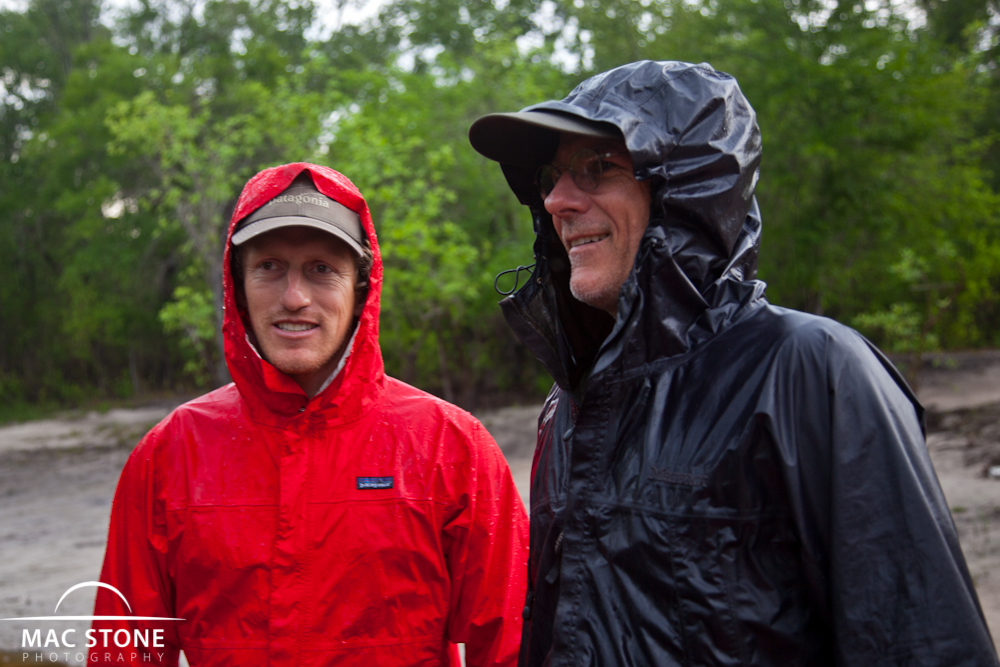
As soon as the sun started heating up the water, the light became too harsh and we pushed back to the camp to make moves for our lunch break at Griffis Fish Camp. It wasn’t until we were halfway there when Carlton told me we were actually stopping to meet up with Mike Fay, THE Mike Fay, who flew in from Washington to also join in on the last push of the expedition. (!!!!!!) Carlton had met Mike while photographing in Gabon and invited him to serve as the ultimate transect guru and guest speaker for their final arrival on Earth Day. If there’s anyone on this planet who knows about major transects to protect land, Mike is the authority.
![]() |
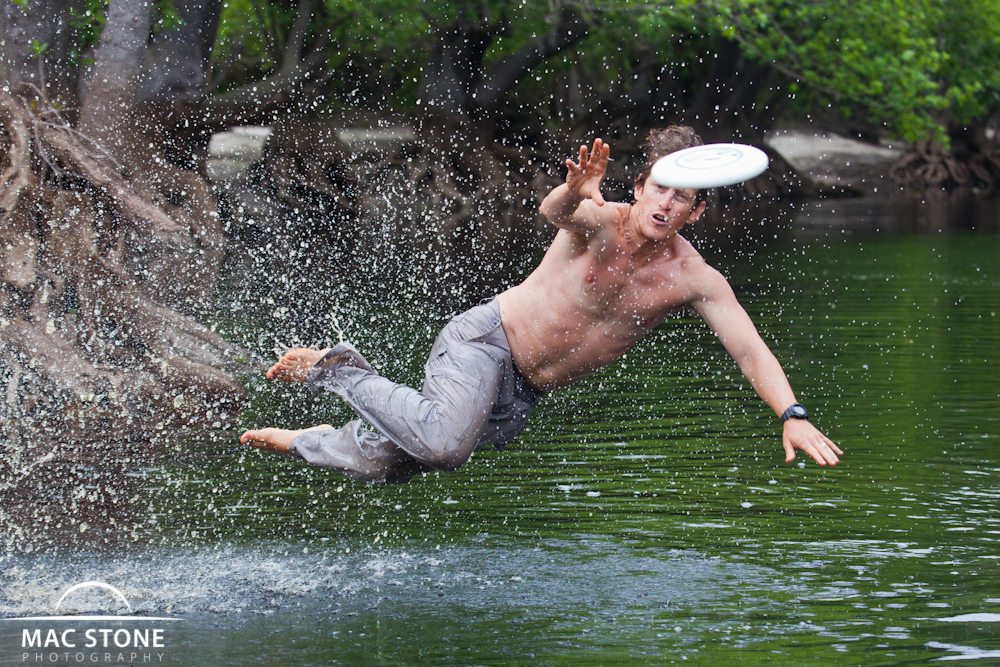
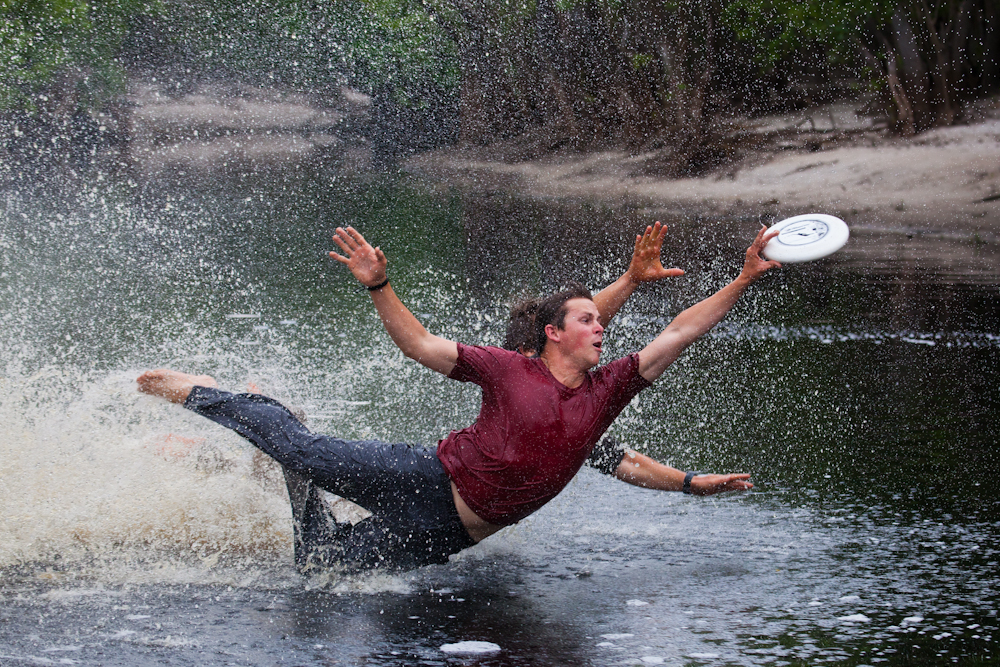
| Carlton Ward gets horizontal for a frisbee |
![]() |
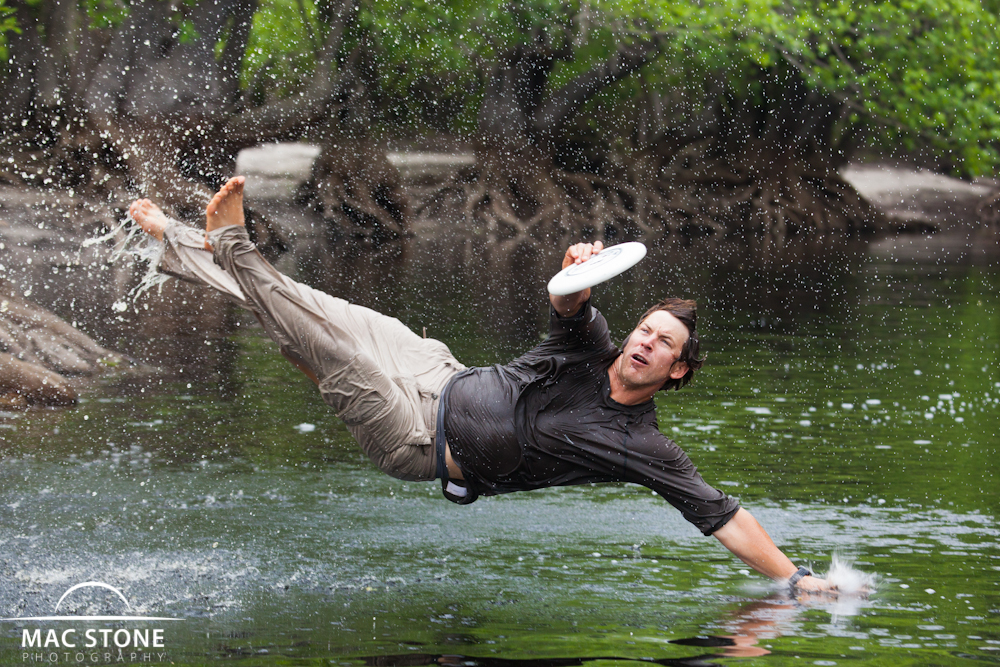
| Joe Guthrie lays out for a disc on the Suwannee River |
![]() |
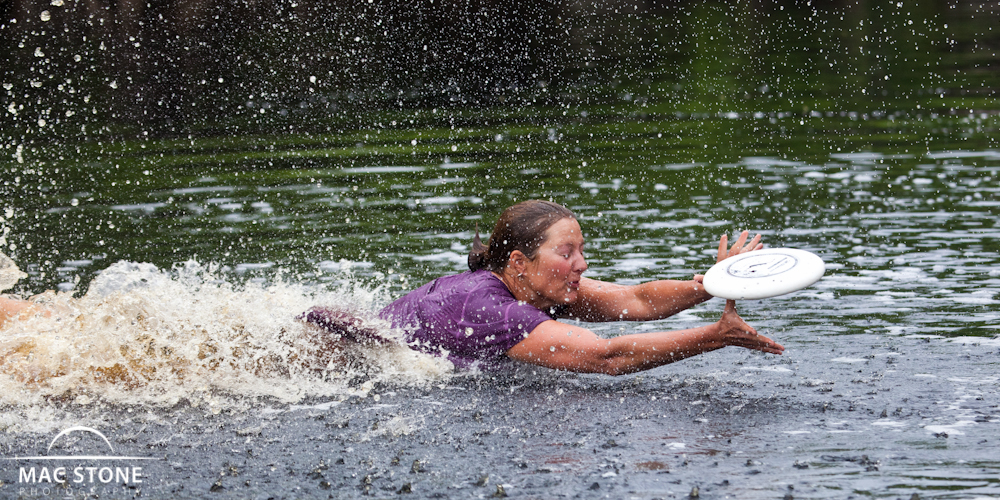
| Mallory Dimmit dives for a frisbee |
![]() |
| Carlton Ward and Mike Fay meet up on the Suwannee River to finish the last miles of the expedition together |
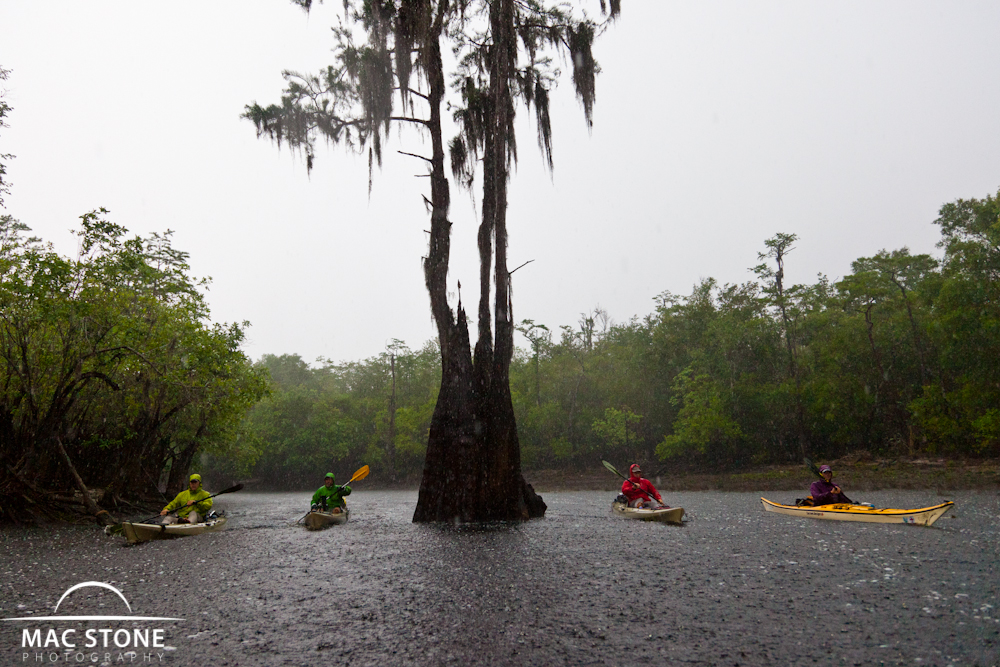
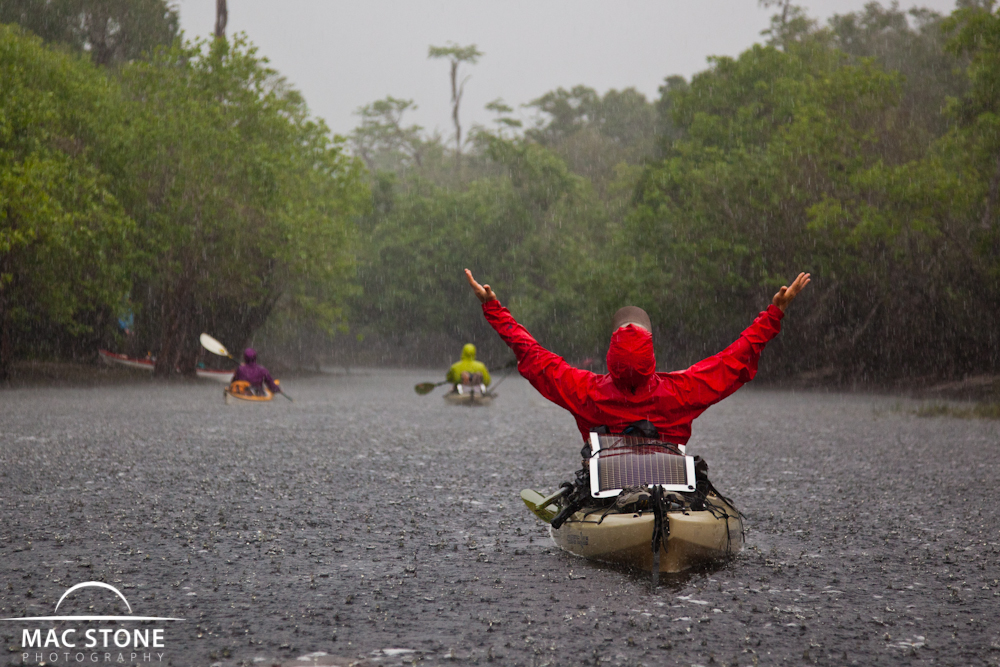
But there we were, all paddling up the Suwannee River into Okeefenokee National Wildlife Refuge and I couldn’t have been happier. Two of my conservation heroes on either side and a darkening sky with promises of thick heavy rain. If I were going to make this look like a hardcore expedition it couldn’t be all sunshine and rainbows. Luckily I packed a large golf umbrella on my kayak specifically for shooting in these conditions and when the skies opened up, I was ready.
![]() |
| Carlton and Joe G. portage over a fallen log |
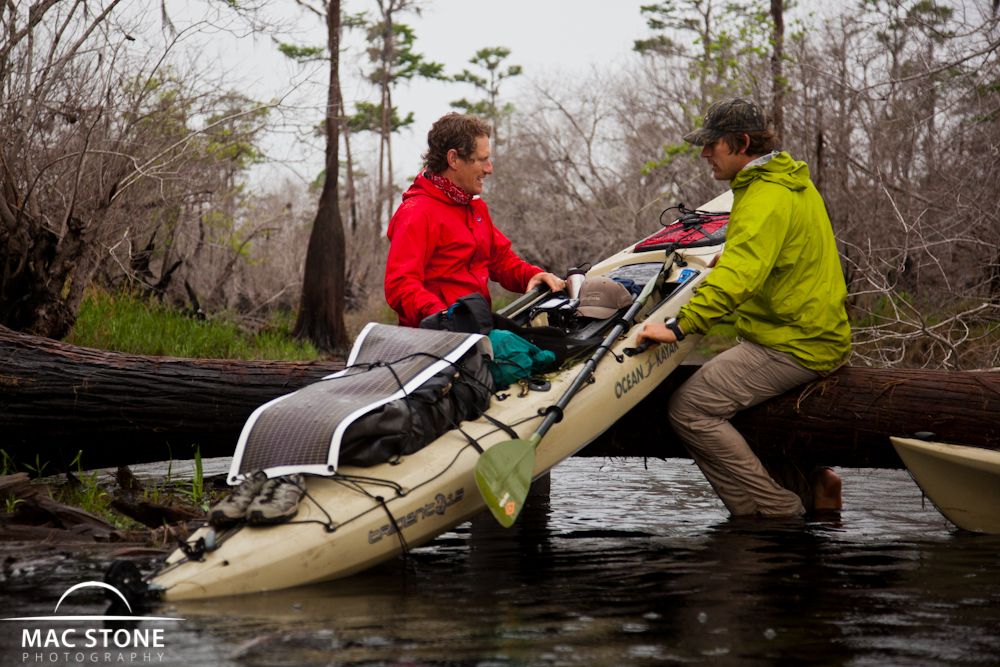
Once the storm passed the Okeefenokee came alive. Prothonotary warblers echoed in the canopy and the lush swamp started closing in around the river. The Suwannee soon turned into a series of braided creeks and diffuse wetland. Trees had fallen across the water and we were forced to make a few precarious portages over the slippery logs. This was all pretty standard procedure to Carlton and Joe, who had seen their fair share of obstacles along the trek. There’s no such thing as an easy path along 1,000 miles of wilderness.
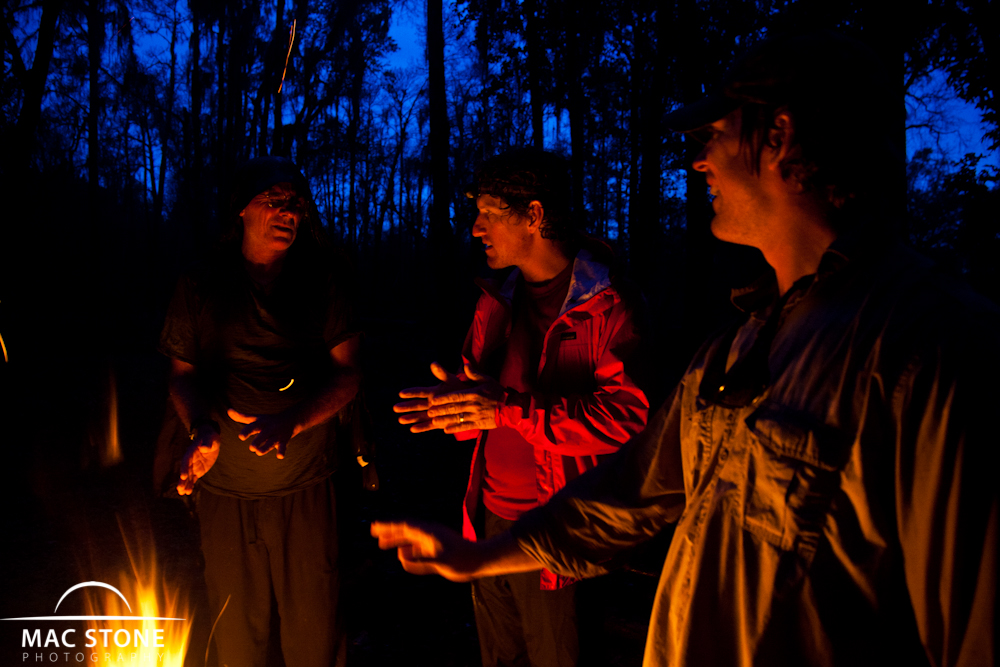
By the time we made it to our campsite, we were soaked to the bone. The rain picked up again and wouldn’t relent. All my camera gear was wet and I wasn’t looking forward to spending the night in a puddle. Not that I had much choice though and plus, I wouldn’t dare voice any complaint, not while in the presence of Mike who battled nearly every single discomfort known to man on his various transects. The chances for a fire were grim, until Joe found his axe and started to chop at burnt pine revealing lighter’d (lighter wood). We used my jet boil to get the coals going and soon enough we were warming up around a roaring campfire. Sweet, sweet, bliss.
![]() |
| Joe Davenport warms himself by the fire |
Around the fire we talked shop all night, discussing gear preferences, cameras, and favorite whiskeys. It didn’t take us long to finish the Maker’s Mark I brought either, giving us that extra warmth before heading to bed. I’m sure for Carlton, Joe, Elam, and Mallory, they feared the fading light of the campfire as much as they welcomed their warm sleeping bags. With the dawn would come an end, a bittersweet finale to an incredible journey. For a crew that’s been shoulder to shoulder for 100 days braving some of Florida’s wildest places I could see how the finish line might actually be a daunting thing.
![]() |
| From left, Mallory, Joe, Carlton, and Elam leave their campsite in Okeefenokee and make way for Steven Foster. |
![]() |
| Elam carries his bags to the boat |
After packing up, the group solemnly made their way to the kayaks. With only a couple miles between them and their welcoming committee at Stephen Foster, they took their time enjoying breakfast and drinking coffee. By 10:00 AM they were on the water and heading for the final stretch. Once momentum picked up and paddles were put to water, the group moved with lifted spirits.
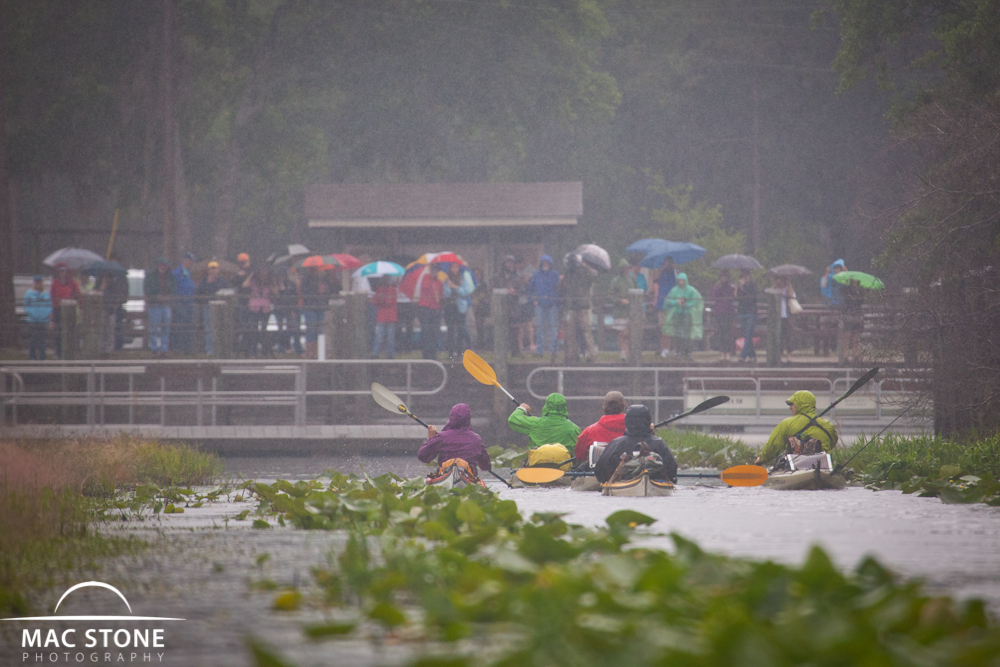
Alligators and warblers traversed the calm river and our kayaks cut through the mirrored landscape. By 12:00 we were at the mouth of the canal leading to Stephen Foster State Park and the rain let loose from the sky again. It was a fitting end; one last push through Florida’s fickle weather to the crowds of media teams and adoring supporters.
Their arrival was well-received and people cheered as Elam, Mallory, Joe, and Carlton disembarked from their vessels. Wives, brothers, sisters, children, and daughters swarmed the expedition team with tears and warm embraces. After 100 days and 1000 miles, they finally made it home.
Dolphin Days
I didn’t plan on doing a video. In fact, I was ready to publish the below blog solely on dolphin photos until I came across this image, and it just sang to me. It typified the sunny afternoons spent in the slipstream of dolphin tails, watching them careen through the emerald Bay. But the image needed a little more motion if I were going to successfully share the experience with viewers. My still imagery is always reliant on the wild imagination of my audience to animate the rest of the story. However, there are just some things that a photo alone cannot capture; like the sound of a dolphin kiss. So, enjoy!There was a three-week period in March where Atlantic bottlenose dolphins seemed to be the running theme to my final days in the Keys. It was as if they followed my boat waiting for good light and their chance to shine in front of the camera.
Everywhere I turned, I found pods of dolphins feeding in the shallows, playing behind my wake, or riding the bow, showcasing their acrobatics and boasting free range of Florida Bay. No matter how many times I’ve seen them though, it’s always a treat knowing that in some capacity they’re as curious of me as I am of them. Surely, it’s a sign of intelligence when a mammal spends a great deal of its time exploring its curiosity, learning and interacting from the world. Or, as scientists like to say, “making sense of the senses.” Not to get too far into detail here, but recent studies are showing that this highly sophisticated level of brain function can be attributed to neurons known as spindle cells. These cells are found in other complex-brained animals like chimpanzees, whales, and apes. Biologists hypothesize that spindle neurons are the building blocks to cognitive learning and comprise the foundation for elaborate social interactions. For someone who works around skittish wildlife that constantly flees at the snap of twig, to have a wild animal approach me for once feels like a gift, a subtle ego-stroke even.
The real gift, however, came from my friends at Dolphin Cove. Jessica Lundstrum, Emily Campbell, and Jessica Lili are dolphin trainers who spend all their time interacting with these incredible animals. I’m sure everyone who ever visited Sea World at one point wanted to quit their job and take up dolphin or whale training. Thousands of people come down to the Keys to dive the reefs and to also spend an afternoon in one of the several swim programs they have around the islands with rehabilitated dolphins. Just before the busy season picks up, however, they need to acclimate the animals to strangers. This is where it pays to have friends at Dolphin Cove. I believe the text I received read like this, “Hey Mac, we need people to swim with dolphins this morning, can you come in?” It was 75 degrees and sunny. My reply? “Nah, I have some things to do around the house… uh… yes!”
Not 30 minutes later I was sitting on the bedrock bottom blowing big air bubbles while four bottlenose dolphins circled and squeaked around me. I strapped on my GoPro and got some fun clips of the playful animals as they tried desperately to figure out what that blinking red light on my head was. I couldn’t believe I waited two years to do this and even more so, surprised when the staff thanked me as I left, which seemed so backwards; like Willy Wonka thanking Augustus for drinking from his chocolate waterfall.