Latest

Man’s Best Friend

In this world there are few bonds stronger than that of a man and his dog. In the Keys, where bars and restaurants kindly open their doors to people and canines alike, many of the four-legged animals begin to socialize and create their own circle of friends. While most locals know each other in the small communities, their pets are often more ubiquitous than their owners. There’s Layla, the barrel-bodied pitbull who’s bull-dozing gait clears tables and chairs if left unattended. Then there’s the half-blind basset hound, Beauregard, a dive bar junkie who lumbers along mopping the beer-soaked floor with his ears. But while these dogs are well-known for their quirky personas and general presence, there’s only one dog who actually engages, entertains, and receives invites at every social gathering. Meet River.

River attempts to place a coconut husk in my hand for one more throw while Badger looks on    

River, an Australian shepherd and labrador mix was adopted by Garl Harrold four years ago. Within the first few months River managed to get her tongue stuck in a Kong ball and Garl faced either a $4,000 surgical procedure or the option to put her down. Fortunately, it was a good year for Garl’s Coastal Kayaking and he footed the bill. To this day, it seems she has tried every possible way of repaying her debt with the hundreds of coconuts she fanatically peels. Piles of husks litter the front lawn and Garl is always quick to offer a fresh coconut water to anyone that visits the house. Her half tongue has left her uncontrollably drooling, sliming anyone that dares to walk near her mouth. After years of shucking the hardened coconuts her canines have eroded down to what looks like a dentist’s solution for delinquent dogs. Garl has tried to ease her into tennis balls, racquetballs, and even baseballs, but she destroys them all the same as if there were something delicious waiting at the center of all round things.

Garl paddles River in Florida Bay on one of his sunset cruises

While Garl is out leading trips into the wilds of the Everglades he has to leave his dog behind. At home, unleashed and unbound River commonly takes off to explore the neighborhoods and retrieve anything that strangers offer to throw. When she’s not out on her own, friends and coworkers come by and voluntarily pick her up to spend an afternoon with the legendary dog. Unfortunately, her forever-loving labrador naivety has landed her in the cars of strangers excited to claim her for themselves. That is, until her captors cease from throwing objects, and finally bored, she follows her internal compass back home. So River, this post is for you. Even though you can’t read, I’ll feel better telling the world that you have made my last few years brighter. Oh, and I’ll go ahead and confess that I may have dropped your name once or twice at Sharkey’s to get the locals discount. So thanks.

Spoonbill Monitoring: Central Everglades

A storm feeds the River of Grass with freshwater in the vast Water Conservation Area of the Central Everglades

While my work generally has me boating and paddling around Florida Bay and the Southern Everglades, the Tavernier Science Center also works closely with the district throughout South Florida. This relationship ensures that we have a comprehensive data set for roseate spoonbills and other wading birds nesting all along the River of Grass watershed. Since nesting starts later the farther North you go, I was invited with coworker Adam Chasey in early March to accompany Robin Bennet and Mark Cook on an aerial survey of bird colonies in the water conservation areas.

“Waterfront properties” in West Palm.

We left out of West Palm Beach and flew over the sprawling city. It looked so alien on the fringe of such a subtle environment.

Morning showers created a rainbow arching over Alley North colony

You all know by now how I am on small airplanes so I was relieved to learn we’d be flying in style; a 407 helicopter, which is one of the smoothest rides out there. A few weeks prior I tried to access these colonies by airboat with University of Florida biologists, but failed miserably when our vessel got stuck in the dense sawgrass and cattails. That’s another story though.

Thousands of white ibis nest on a tree island in Water Conservation Area 3

Our main goal was to get spoonbill counts and see if we could spot bands which would tell us if our birds from the Bay were moving north to find other suitable nesting grounds. This turned out to be a tall order, however, as we learned the hard way. I thought that with a helicopter we’d be able to set down and explore the colonies on foot to find nests and adults within a photographable distance. What we learned after walking 30 feet into the waist-deep mire revealed that these tree islands are far different from the mangrove islands on the Bay. Too easily turned around and unable to see above the sawgrass which lacerated our arms and legs, Adam and I returned to the helicopter and attempted to photograph spoonbills from the air.

A flock of spoonbills takes flight over the Everglades. If you look closely, the second from the left bottom has a band on 
its right leg, hinting that our Florida Bay birds may be more mobile than we originally thought. 

Thanks to our phenomenal pilot, Jake Wells, we were able to fly wing to wing with a small group and in no time, spotted our first band! For someone who spends most of his days looking up at spoonbills soaring across a blue sky, my heart melted as I flew side by side with these pink beauties. What an experience and better yet, what great data!

Loxahatchee River

An adult barred owl sits atop a bald cypress, calling to its mate on the Loxahatchee River

There are only two rivers that flow freely into Lake Okeechobee, Fisheating Creek is one, and the Loxahatchee is the other. Before we started replacing our natural waterways with canals, Floridian creeks and rivers had personality, a sinuosity marked by thousand-year hardwoods and abundant wildlife. For this reason, unaltered rivers like the Loxahatchee are our best windows into the past. Early this month I had the unique opportunity to spend two days camping on the river while conducting spoonbill research via helicopters in the central Everglades. Fortunately, Adam Chasey and I met up with Radio Green Earth host Jim Jackson and Albrey Arrington, the Chief Executive of the Loxahatchee River District to learn more about the area and its role in Everglades Restoration. You can hear some clips of the recorded show in the podcast section here: RadioGreenEarth.org

I always wanted to put a paddle in the famed Loxahatchee. Its century-old cypress and winding blackwater gives it the title “Florida’s most scenic river.” Surprisingly it’s relatively unpopulated even on a weekend. When Adam and I were launching our canoe a couple came over to us and asked how we found out about the river, as if it were a local secret. I love places like this!

Our first day on the river we paddled a little over two miles in 4 hours. Not because it was a difficult paddle, but because it was difficult to stay in the boat and stop exploring the high banks studded with twisted cypress knees. On a branch not more than ten feet off the water a pair of barred owls preened and flirted paying us no attention.

Palms hung over the river, so of course we had to see who would be daring enough to walk across, which then promptly turned into a game of chicken, “who can go no hands… upsidedown?” This is my kind of swampin… I can’t wait to go back!

American Crocodiles:

American crocodiles are probably my favorite animal in the Everglades. I grew up with alligators, played tag with their tails, swam with them, and even caught a few (all of which I would never condone). They’re a dime a dozen in most Florida waterways. Everglades National Park, however, is the only place in the world where alligators and crocodiles share the same space. Double bonus! I’ve photographed alligators so many times that I’m constantly trying to find new ways of photographing them.

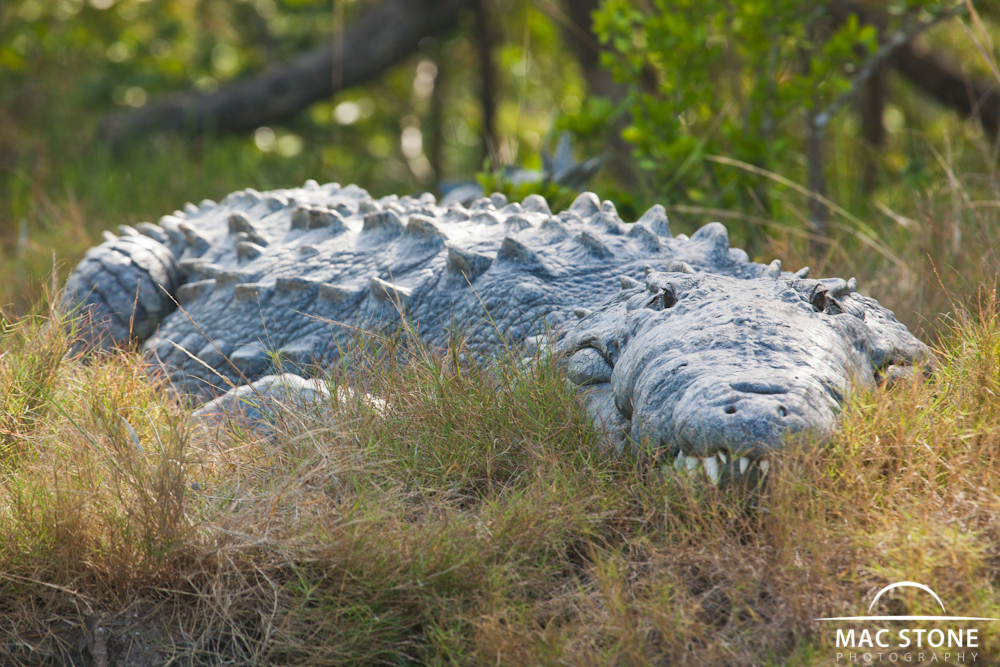
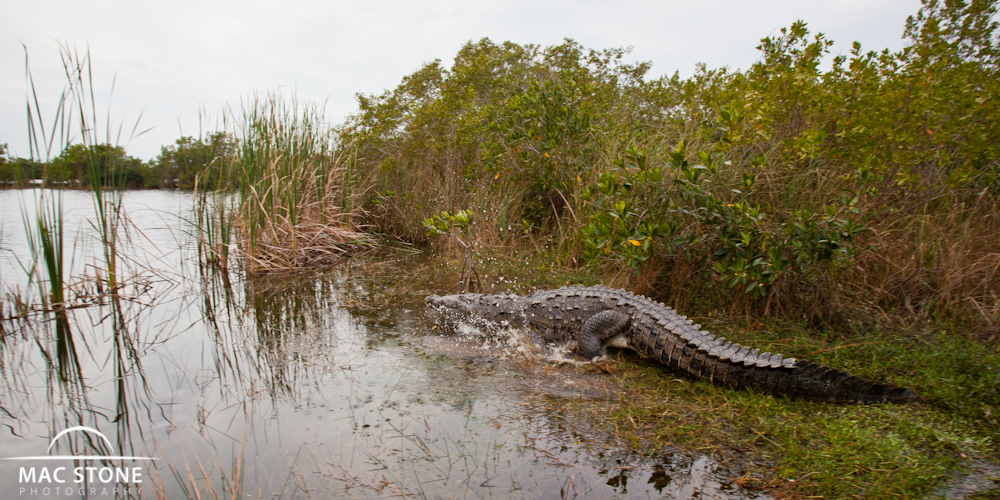
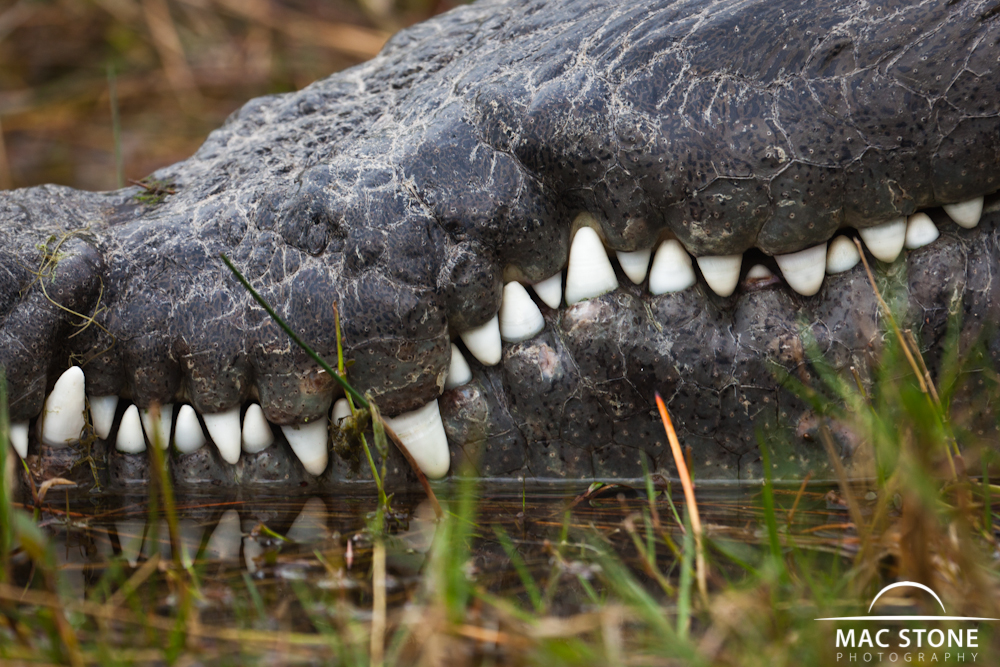
Crocodiles, however, are completely different beasts. In the United States they are considered endangered species and estimates range from 2,000-3,500 individuals. Besides the physical differences (longer snout, more abrupt scales, coloration, eye color, and jaw line), American crocodiles seem to have little in common with the alligators I came to know as a kid. While their gaze and exposed teeth are more menacing, they’re actually incredibly shy and tough to approach. I’ve tried for nearly two years to capture a worthy image of these reptiles without much luck. It always seems that just as I am closing in with good light and camera ready, they scuttle off into the murky water. I do, however, have plenty of images of a giant splashing tail.

A large, 12ft crocodile basks at the edge of Lake Ingram

I embrace these types of challenges, though. The trick to any wildlife photography is figuring out the animal’s habits and then putting yourself right in the middle of it. Reptiles are fairly predictable creatures. Knowing that above all else they need to warm their bodies by sunlight, I tried a technique I employed while in South Carolina. Setting my camera trap up at one of their favorite basking locations I let the shutter run for three days at 2 minute intervals. I was disappointed not to find a single crocodile when I returned to retrieve the camera but they simply have too many places they frequent to depend on one location with a static, un-manned camera. I needed a bottleneck; some sort of biotic or abiotic factor that would increase my chances of getting close.

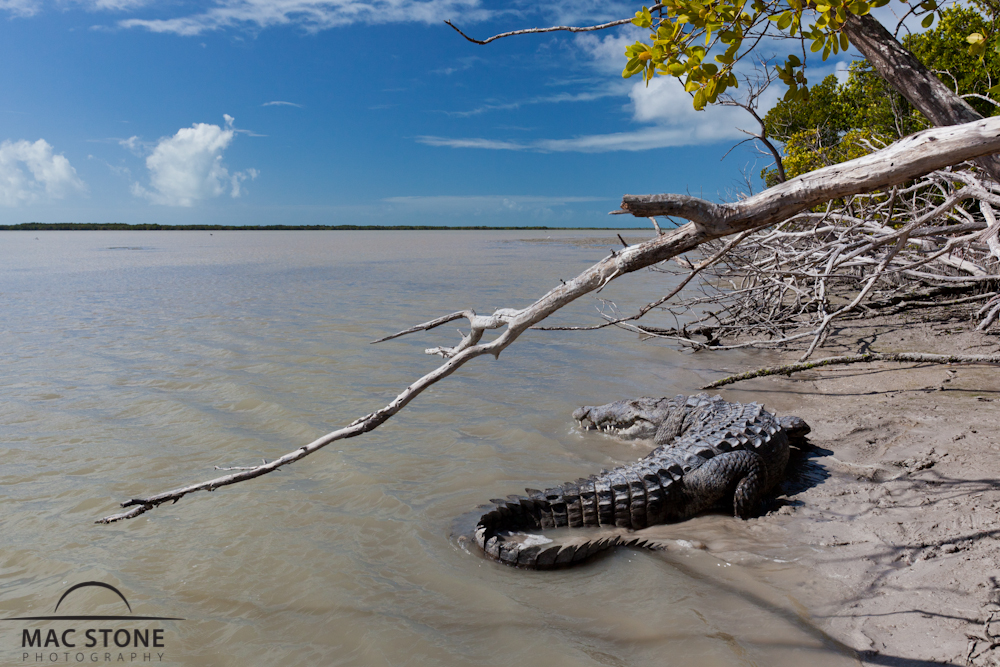
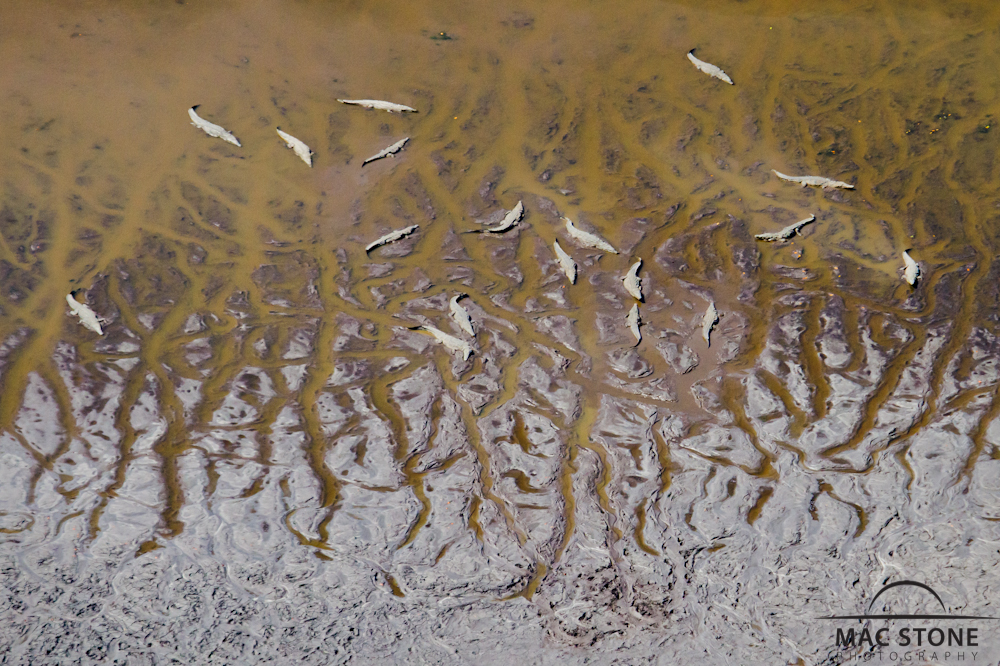
Crocodiles gather on a mud flat along the southern tip of Florida.

Taking to the air, I scouted out locations where I thought they might congregate. It turns out flying over Cape Sable during a cold winter day the best way to see American crocodiles in the Everglades. While this made for a couple “keeper” images, I needed something better, closer, where viewers could get right down in the dragon’s lair.

Luckily I’m not the only one down here who thinks these sorts of missions are fun. A few friends of mine, Garl Harrold, Mark Parry, and April Geisler were all patiently waiting for a cold weekend to sweep through the Everglades this winter to get close looks at crocodiles. We had one day where the temperature was just barely cold enough and water levels moderately low to concentrate the reptiles in a few remote locations. I had my bottleneck!

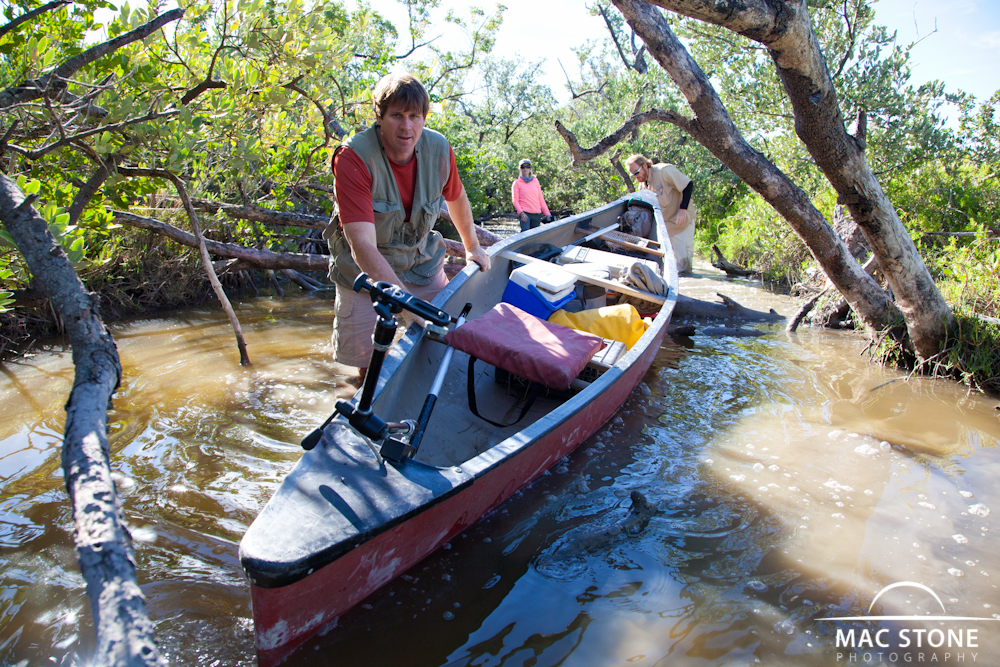
Garl Harold (front), Mark Parry, and April Geisler portage the canoes through a shallow creek

We woke up at 4 AM and trailered a boat loaded with a kayak and canoe out to the park. Putting in right at sunrise we headed out for the Cape Sable area. Anchoring the boat, we portaged the kayak and canoe loaded with enough food, water, and camera gear through salt marsh until reaching the water. While I cannot disclose where this area is, I will say that it’s no easy task to get there.

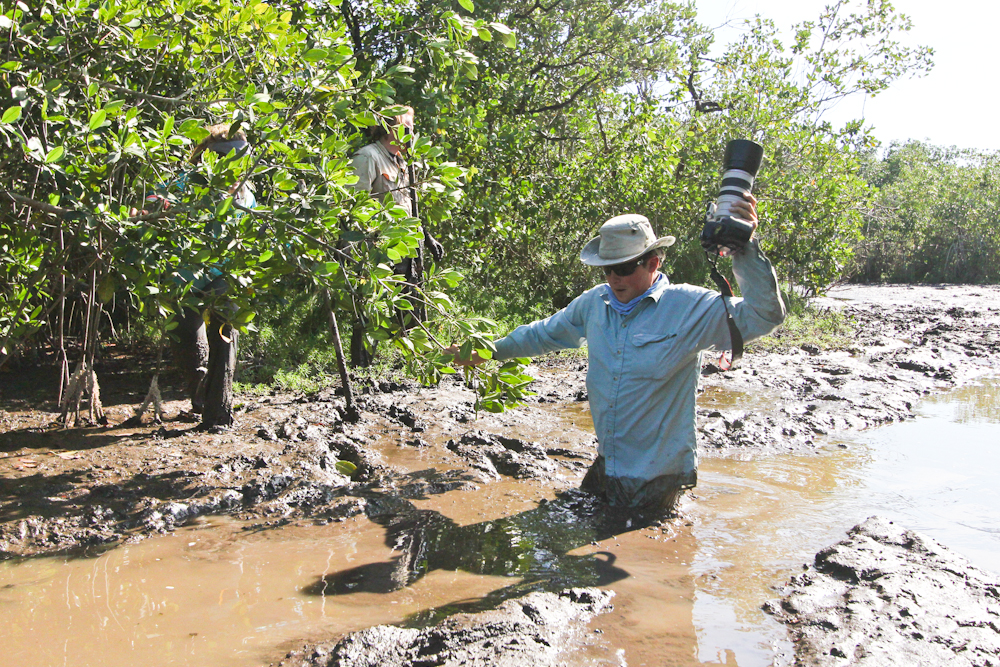
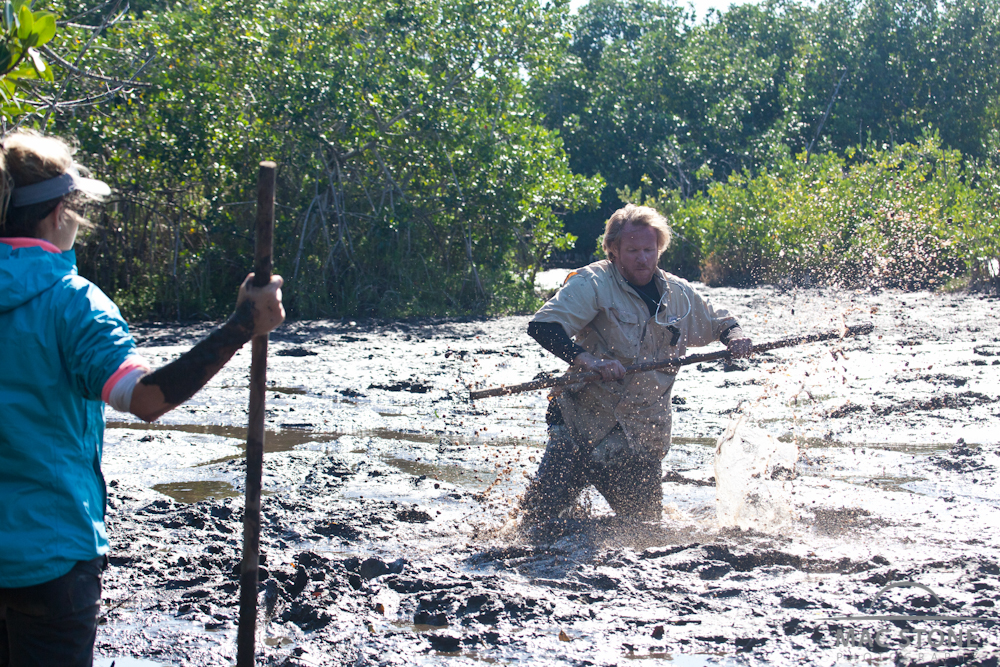
This deep, thick mud pit held me for about 5 minutes before I freed myself. 
Luckily no cameras were injured in the making of this photo. Photo by Garl Harrold

Paddling 7 miles, we finally made it to the mud banks where the year prior I saw over 40 crocodiles, only to find they had all slipped into the water. It turns out the 60-degree weather just wasn’t cold enough to keep them from moving. I was almost heart-broken. Muddy, wet, sore, and tired, I knew I’d have to wait another year for a shot like this.

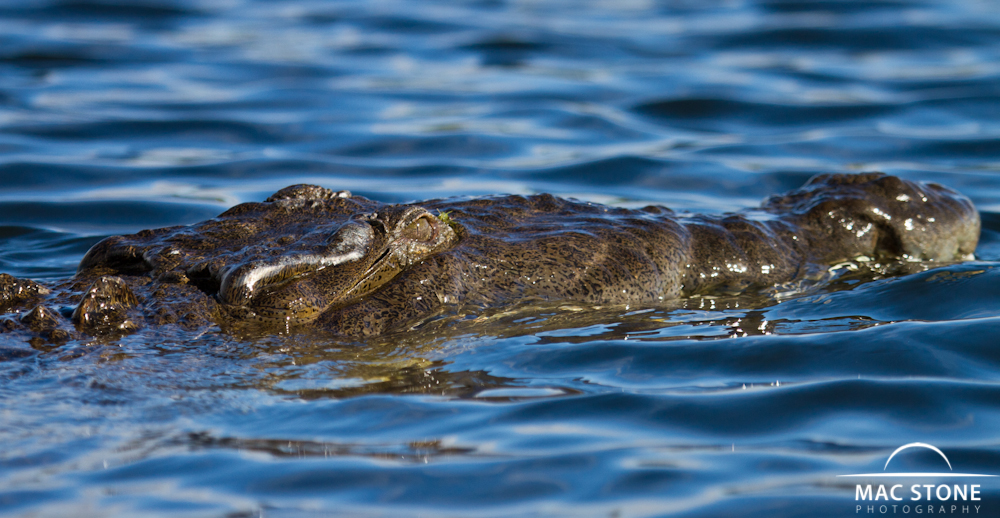
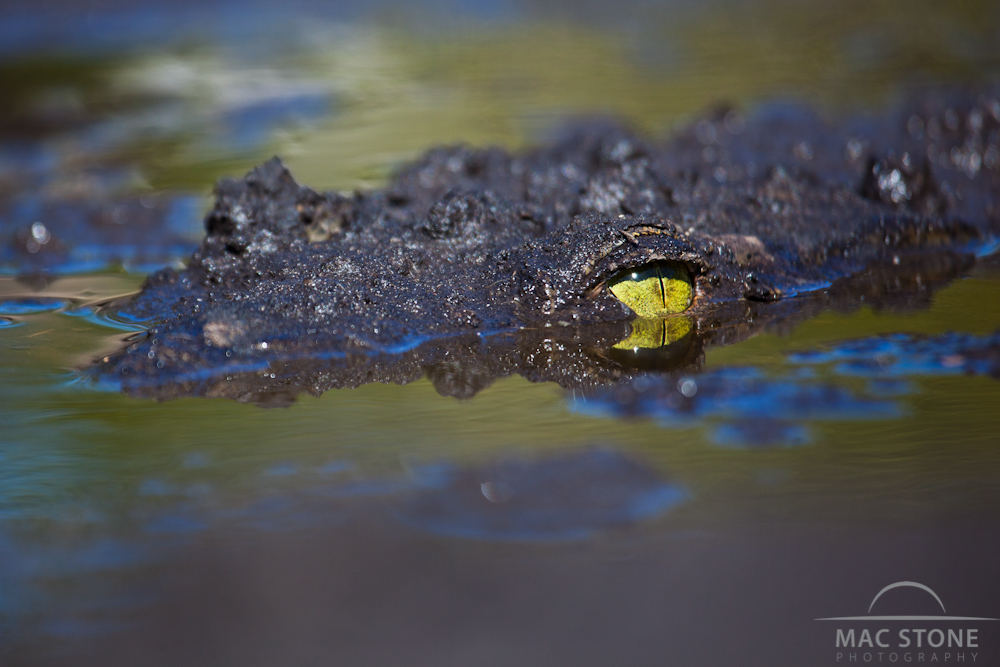
An American crocodile in its natural habitat reveals only a glowing green eye.

Disappointed, we anchored the boats and started eating lunch until Mark yelled out from the shore that he found a croc still submerged in the mud. We slogged over and it took me about a minute to actually see the crocodile. Its whole body was camouflaged with the mud and the only part visible was a neon green and yellow eye glowing in the afternoon sun. This is what I came for!

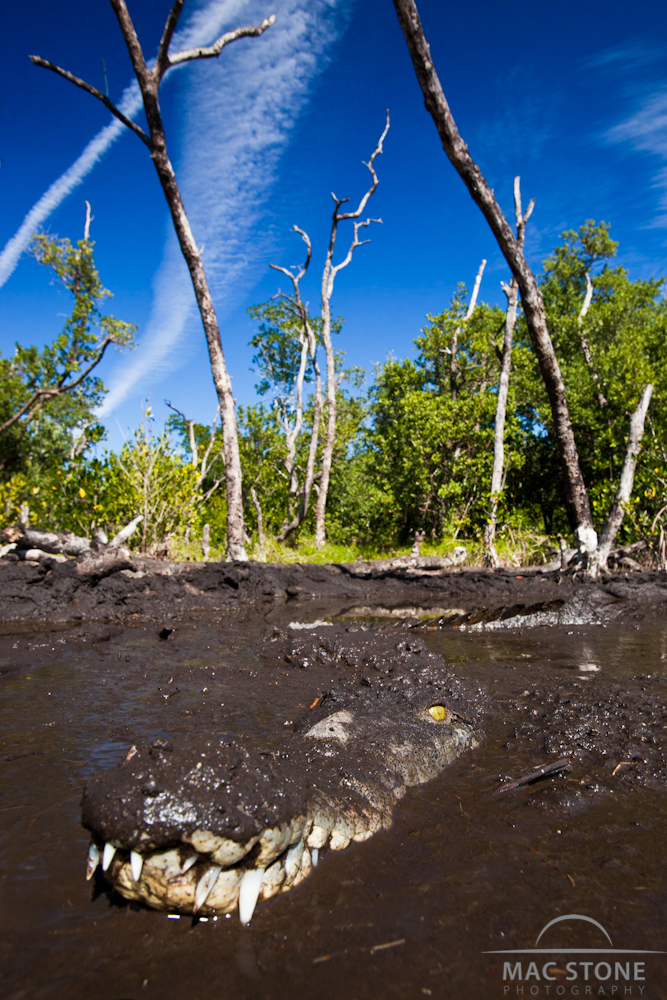
Slowly and cautiously, I walked around the crocodile so as not to scare it off or scare it towards me, and began shooting photos from a distance. Once I felt the 8-foot croc was comfortable or tolerant of us being there, I moved in a little closer. The tingling in my fingertips and tension in my thighs felt the palpable presence of wild nature. Those of you who have been close to large wildlife, know exactly what I’m talking about. I want to believe I made a connection with this crocodile, that we bonded for a moment, but the biologist in me knows that it’s a simple calculation in the crocodile’s mind which allowed me to stay. It was cold and he didn’t want to spend the energy to defend his spot. Ten very sweaty and nervous minutes later, I had the image I’d been envisioning for the last two years.

The difference between how I felt just before biting into my lunch, knowing that we hadn’t found the crocodiles we came to see and finding ol green-eye laying up in the mud was a complete 180. I know I shouldn’t rely on wildlife for the barometer of my happiness, but after years of planning I was too emotionally involved. Treasure hunters probably feel this way all the time. Luckily this year we didn’t come up empty-handed, or one-handed for that matter.

All jokes aside, wild crocodilians are not what I would consider to be aggressive animals. When unprovoked and unmolested they are simply observers and tend to avoid humans at all costs. To them, we’re big potential predators and they want nothing to do with us. To assume that every alligator or crocodile is just waiting for a chance to bite people is baseless. To this day there still has yet to be an unprovoked alligator or crocodile attack in Everglades National Park and there is no shortage of tasty tender-skin tourists running around. Still,  I do not encourage people to get close to alligators, crocodiles, or other animals. I was accompanied by a wildlife biologist who works professionally with crocodiles and alligators and I myself have years of experience with these animals. No crocodiles were harmed in any way in the making of these photos. Please do not attempt this in your local swamps or parks.

Savage Race Orlando

I’m finally getting around to editing the thousands of photos I shot at Savage Race held in Clermont, Florida at Revolution Off Road two weeks back. As promised by the Savage Race staff, this race was a definite upgrade from its debut in August of 2011; more obstacles, more competitors, more spectators, more mud, and less gale force winds! Although the thunder and lightning of last year’s event put the final savage touch on the course, this year people were able to enjoy the food, beer, and live band provided by the race. These events are so much fun to shoot because there are so many opportunities for great action and raw emotion.

Here are some of my favorites: 

 Even Stuart Scott, host of ESPN made it out to Savage Race, and finished strong!


The “best obstacle award” definitely goes to the ice bath which was an industrial-size garbage container filled with 2 feet of ice and water. I spent a lot of time there, just getting people’s faces as they emerged from swimming under a brutal barrier that divided the tank. These are the faces that scream “I can’t believe I paid for this torture!”

Of course I couldn’t just sit around and watch everyone else have all the fun, especially with my brother, uncle, and cousins having finished (the latter ran it twice!), plus I was already a little muddy just from shooting photos… so once everyone had crossed the finish line, I put on my five fingers and convinced coworker Adam Chasey to go with me. 
Me crossing the last obstacle, “mud n guts.” Photo by Pat Abbitt
What a great way to spend a Saturday. I can’t wait for the next event! The word on the street is they’re looking for more venues in other states… 

Arthur Marshall Foundation: It’s My Everglades

Two months ago I was invited to join a canoe expedition sponsored by the Arthur R. Marshall Foundation. It was my job to document their third consecutive year of traveling the historic River of Grass. The leg of the trip that I joined was from Sawgrass Recreation Park down to the Tamiami Trail, about 76 miles.

Two years ago the expedition started at the Arthur R. Marshall Loxahatchee Wildlife Refuge and planned to follow the water all the way down to Florida Bay, in order to raise awareness of South Florida’s need for clean, free-flowing water. Today the expedition has become a massive effort to involve the public, especially children, with Everglades restoration. Embracing the new technologies, we would set up live from-the-field video classrooms using iPads with elementary schools all over south Florida and describe to the students what we saw and experienced while on the water.

I love multi-day expeditions and I jumped at the offer. I made sure to pack as light as possible, even though my camera gear alone weighed 60 pounds. In order to compensate I left all articles of what I deemed “unnecessary” at home only to learn that I would be the only one without a pillow, sleeping pad, or camp chair. Bummer. Fortunately though, I had no problem sleeping after the gourmet meals, provided by the phenomenal cook Gisa Wagner. I’m pretty confident this was the only time I’ve had lamb stew and fresh broccolini marinara pasta, of course with grated parmesan cheese. This is my style of camping!

On the last night we wanted a group camp photo, so we lit up the tents during a 30 second exposure while people 
walked around the campsite with headlamps ablaze. 

On the last day of our trip we pulled into the Tamiami Trail boat ramp. Only a few hours later, the Florida Wildlife Corridor Expedition team, Carlton Ward Jr, Joe Gutherie, and Elam Stolzfus rolled in exhausted from the last grueling 5 days of their journey from Florida Bay. When I saw their faces, I felt horribly guilty of those delicious calories I had marinating in my stomach. Well, sort of.

  Carlton Ward Jr portages his kayak over Tamiami Trail

I hope you enjoyed the video. I must say thank you to the Arthur Marshall Foundation and the talented and brilliant paddlers I met while on the trip. I can’t wait until next year.  Also a special thank you to Susan Sylvester, who is entirely to credit for any footage I got while on the water. I promise I’ll try to rig up a system where I can shoot and paddle at the same time for our next trip!  

Roseate Spoonbills

Newborn roseate spoonbill chicks in Florida Bay

Numbers of roseate spoonbill nests in Florida Bay are slowly climbing as we explore new territories. It’s encouraging to see them rebound after a slow and steady decline over the last 15 years. Islands that we never considered suitable for the pink birds are surprisingly hosting good-sized colonies and reshaping our ideas of their nesting and foraging habits. 

Chicks around the age of 12 days, known as Stage II, will spend another 20 days on the nest before making their first flights. 

We’re finding a healthy variation of chicks at different stages, from hatchlings to fledglings, all across the Bay. This isn’t out of the ordinary but it helps us see how these birds’ nesting schedules are related to food availability. For example, in the northwestern section of the Bay where tides control water levels, spoonbills nested earlier in the season because they could find sufficient food as tides withdrew. When you boat eastward where wind and rainfall controls water levels, you find that spoonbills choose to nest later, waiting for the dry season to kick in. Once water levels are low enough to amass fish in large concentrations, adults will commit to laying a clutch. With shallow water bringing an abundant food source, adults will be able to sustain their young through the nesting season. That’s the plan, at least.

A chick only a few days shy of fledging the nest lays motionless below its nest after a cold front in February. 

Recently a cold front pushed through south Florida and dumped rain for three straight days. What seems like a small event to us, a 4-inch rise in water levels effectively disables the spoonbills from accessing optimal foraging grounds. Immediately after, across the board, we witnessed an abandonment of nests and several chicks not far from fledging, washed up in the mangroves. While it’s too early in the data set to directly connect the rain event to nest abandonment, we can’t say it was entirely coincidence.

A Stage II chick, about 10 days old is found lifeless in the rain-soaked red mangrove prop roots

I can’t tell you how heart-wrenching this is to see, how helpless they look, but it’s the reality that these birds live with. Albeit disturbing, this is exactly the point Audubon is trying to drive home. Water levels determine everything in the southern Everglades and Florida Bay. While we can’t control the weather, we are controlling the water flowing from the north and we must be extremely careful with how we use it

Radio Green Earth

Jim Jackson (left) interviews Jerry Lorenz for his show Radio Green Earth

The Tavernier Science Center has had a small spike of news coverage the last month with visits from Audubon Magazine, The Free Press, the Miami Herald, and just recently RadioGreenEarth.org. We always appreciate media outlets getting the word out about our research. We especially enjoy letting them see exactly what we have to go through in order to get our kind of data. I knew, however, that of all people, Jim Jackson would be up for the challenge.

I met Jim while out on a paddling expedition with the Arthur R. Marshall Foundation and when I told him about our research, he jumped on the opportunity to tag along. Here’s an edited podcast of the show if you ever wanted to hear what it was like walking a day in our shoes.

Saving Lake Okeechobee

Last winter I had the privilege to spend an afternoon with Nathaniel Reed on Lake Okeechobee. I was shooting a piece for Audubon Magazine about the lake and one of its most important conservationists to date. I’m excited to finally share with you the video that was released online a couple weeks back, edited by Bob Sacha and produced by Lila Garnet.

Paul Gray, one of the best Okeechobee guides, uses an airboat to navigate the marsh.

Hopefully this won’t be the last assignment with the magazine for these short web-based videos because they are so much fun to put together. This project simply couldn’t have been done without the help of Don Fox, Paul Gray, Rene Ebersole, Bob Sacha, Lila Garnett, Eric Draper, and of course, Nathaniel Reed.

Flamingos!

Juveniles and adults preen Lake Ingram in morning light

You may remember a post I did back in August of last year where I freaked out about getting to see my first flamingo in Florida Bay. Pete Frezza and I pulled around for nearly 15 miles trying to get a good glimpse of that one bird and I thought it would be my last chance. Oddly, this year for a period of about three months a group of 19 flamingos found refuge in Lake Ingram. A frenzy ensued with birders, photographers, and anglers trying to get good looks at these birds, and there they were; a mix of adults and juveniles not 20 yards from one of the busiest channels in the park. Biologists are guessing they’re Bahamian birds and hopeful that they’ll continue to use Cape Sable as a foraging ground. I just stoked I was able to see this incredible sight before they flew back home.

Design a site like this with WordPress.com
Get started